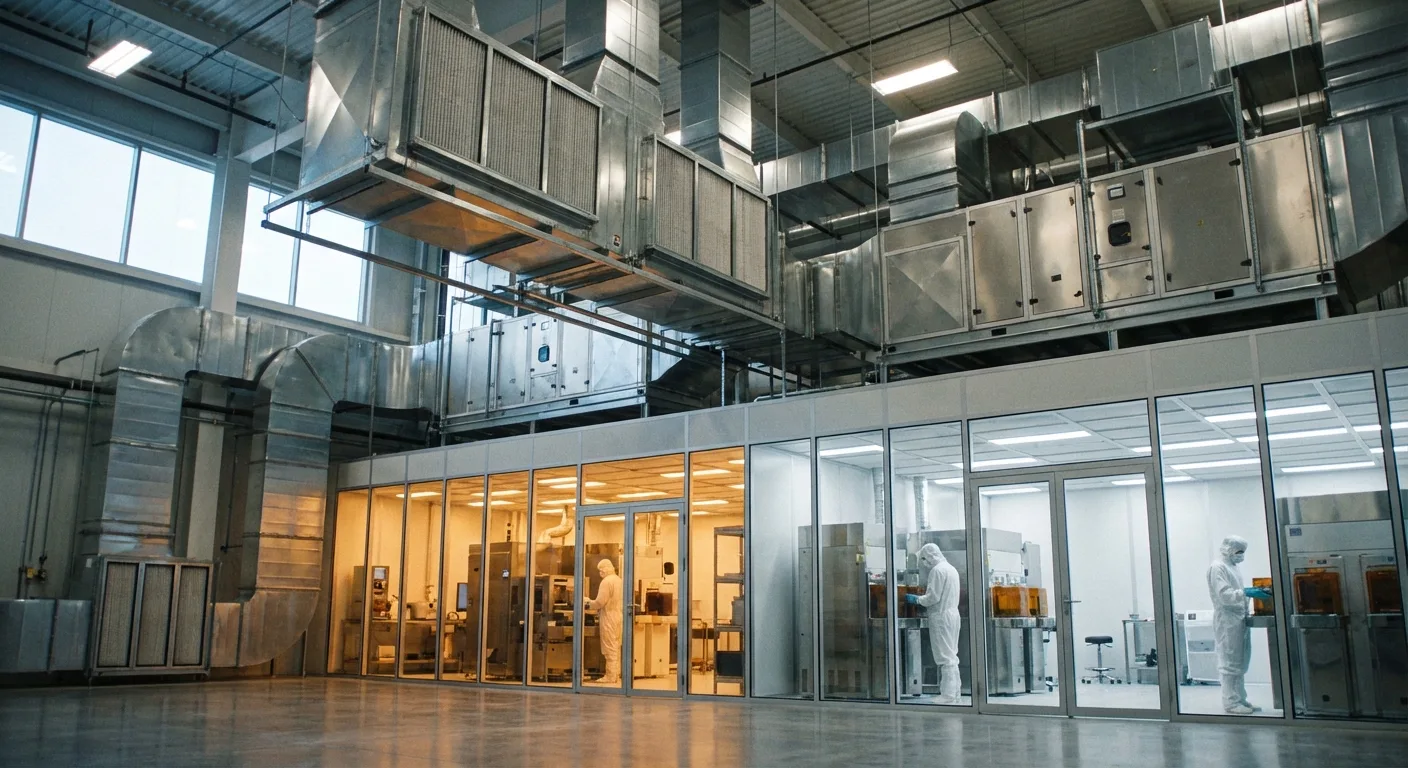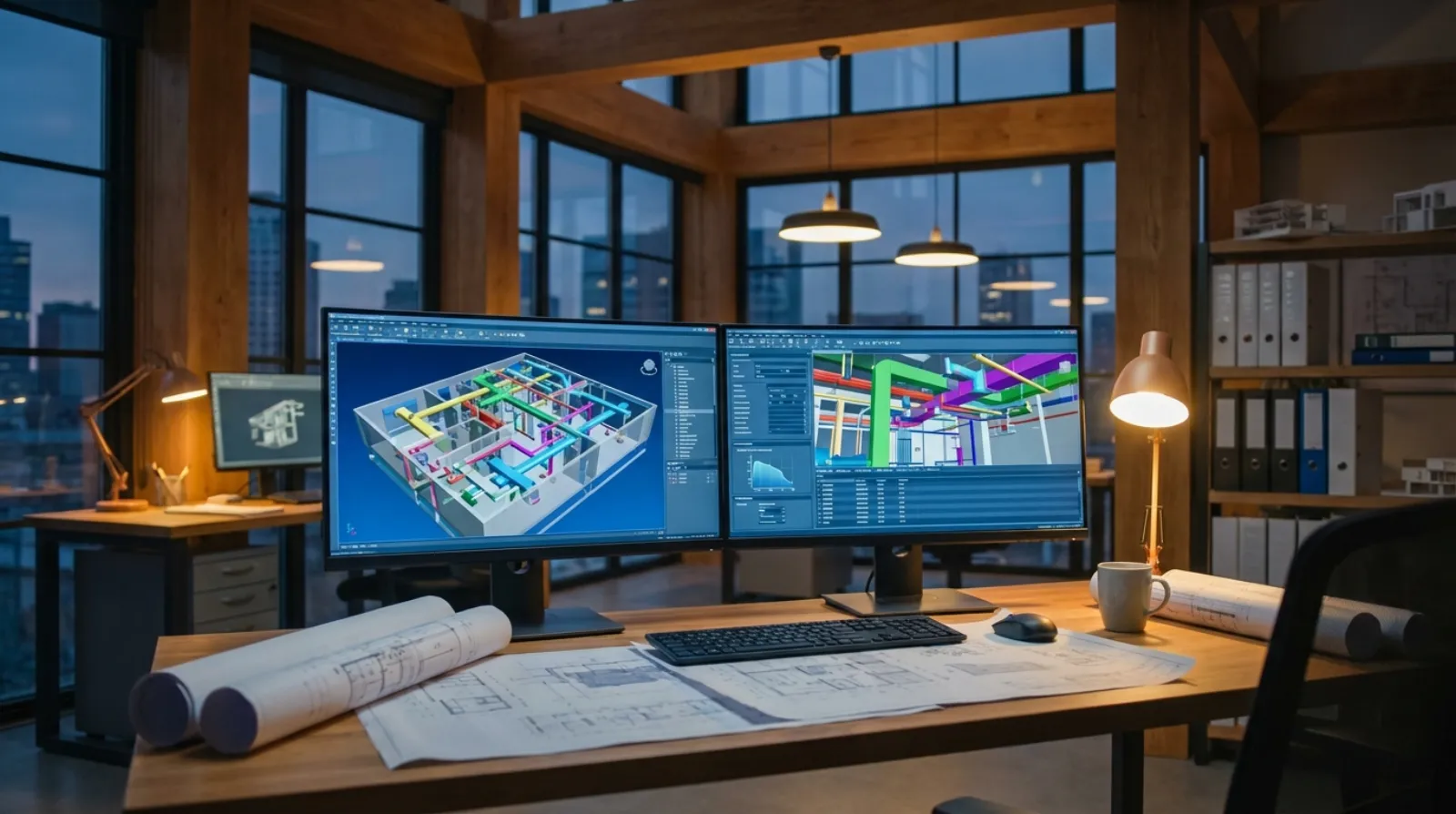
HVAC engineering design is a profession that relies heavily on cross-disciplinary knowledge integration -- from building thermal physics, fluid mechanics, and thermodynamics to regulatory compliance, equipment selection, and construction coordination, a senior HVAC engineer handles an astounding volume of information and decision density in a single project. Yet the core workflows of this industry have remained fundamentally unchanged for the past thirty years: manually inputting building parameters for load calculations, individually browsing equipment catalogs for performance comparisons, and repeatedly adjusting duct routes in CAD software. The maturation of AI Agent technology is bringing a truly revolutionary breakthrough to this traditional engineering workflow[1]. This article examines how AI Agents are becoming the most powerful intelligent assistant tools for engineers across every phase of HVAC engineering design.
1. Current HVAC Engineering Design Workflow and Pain Points
A typical HVAC system design project, from inception to drawing completion, must go through at least five major phases: building condition analysis, thermal load calculation, system selection and equipment configuration, duct/pipe routing and hydraulic calculations, and code compliance and energy efficiency verification. Each phase carries risks of information discontinuity, repetitive labor, and human error.
The Information Extraction Bottleneck
The starting point of design is architectural drawings -- typically dozens of pages of floor plans, elevations, sections, and material schedules. HVAC engineers must manually extract parameters for each space including area, height, exterior wall orientation, glass area and type, roof construction, occupant density, and more. A 20-story commercial building may contain over 200 spatial zones, each requiring 15-20 input parameters, meaning 2-3 days of work just for data entry at the design outset. The more serious problem is that when the architect modifies the design -- which happens extremely frequently in practice -- the HVAC engineer must re-compare the changes and manually update all affected parameters.
The Black Box Dilemma of Load Calculations
Building thermal load calculation is the foundation of HVAC system design. The methods commonly used in the industry include ASHRAE's Radiant Time Series (RTS) method and Heat Balance (HB) method[2]. While theoretically mature, these methods face several practical challenges: complex software operation, implicit parameter assumptions, and high sensitivity of results to input values. A small deviation in glass SHGC value can cause a 10-15% difference in cooling load calculations. Engineers often resort to conservative safety factors due to time pressure, leading to system oversizing, which not only increases initial investment but also reduces energy efficiency during partial load operation[3].
Information Overload in Equipment Selection
After load calculations are complete, engineers must compare performance curves, dimensions and weights, electrical requirements, and maintenance conditions across dozens of equipment manufacturers' catalogs for chillers, air handling units, cooling towers, pumps, fans, and dozens of other equipment types. Selecting a single centrifugal chiller involves comparing over twenty parameters including IPLV/NPLV efficiency, cooling water temperature conditions, part-load performance, noise levels, refrigerant type, and life-cycle costs. This process is highly dependent on personal experience and limited by the engineer's familiarity with specific brands.
2. AI Agent-Assisted Building Thermal Load Calculation
The most immediately visible application of AI Agents in HVAC engineering design is automating building condition extraction and thermal load calculation. An AI Agent refers to a large language model application architecture with autonomous planning, tool invocation, and multi-step reasoning capabilities[4]. Unlike traditional single-query interactions, Agents can decompose complex tasks, sequentially invoke external tools, and dynamically adjust strategies based on intermediate results.
Automated Architectural Drawing Parsing
Combining multimodal Vision Language Models with OCR technology, AI Agents can directly read PDF or image files of architectural floor plans, identifying spatial boundaries, dimensional annotations, door and window positions, and construction material markings. The Agent can structure recognition results into JSON-format space inventories containing each room's area, perimeter, exterior wall length, glass area, and other key parameters. When architectural drawings are updated, the Agent can automatically compare differences between old and new versions, flagging affected spatial zones to dramatically reduce design change response time.
Weather Data and Envelope Parameter Integration
AI Agents can automatically query TMY (Typical Meteorological Year) weather data for the design location, extracting design day dry-bulb temperature, wet-bulb temperature, solar radiation, and wind speed parameters. Taking Kaohsiung as an example, ASHRAE design conditions show a 0.4% cooling design dry-bulb temperature of 35.2 degrees C and wet-bulb temperature of 28.0 degrees C[2]. The Agent can automatically integrate these meteorological data with the building envelope's U-values, SHGC values, and airtightness ratings to generate complete load calculation input files and call EnergyPlus or TRACE 3D Plus calculation engines for simulation[5].
Intelligent Review of Calculation Results
AI Agents can not only perform calculations but also conduct reasonableness reviews of the results. For example, when a space's cooling load per unit area exceeds the empirical range for that usage type, the Agent will automatically flag it and trace back to check input parameters -- this mirrors the thought process of a senior engineer reviewing drawings, but the Agent can perform this check simultaneously across hundreds of spaces in seconds.
3. AI-Driven Equipment Selection and Life-Cycle Cost Analysis
Equipment selection is the most experience-dependent phase of HVAC engineering design, and also a domain where AI Agents can deliver tremendous value.
Automated Performance Curve Comparison
AI Agents can simultaneously parse performance data from multiple chiller manufacturers -- including AHRI-certified rated performance, part-load efficiency curves (IPLV/NPLV), and correction factors for different cooling water temperature conditions. Based on the project's specific Load Profile, the Agent calculates each candidate chiller's weighted annual energy consumption under actual operating conditions, rather than merely comparing rated efficiency. This comparison based on actual operating conditions often yields conclusions dramatically different from rated efficiency rankings[3].
Multi-Chiller Combination Optimization
For large building chilled water system design, the number and capacity ratio of chillers is a critical decision affecting the system's annual energy efficiency. AI Agents can explore all feasible chiller combination options under given total cooling capacity constraints -- for example, 2 large + 1 small, 3 equal capacity, or 1 large + 2 medium configurations -- simulating 8,760-hour annual operation strategies for each combination, calculating 20-year life-cycle costs including electricity, maintenance, refrigerant costs, and equipment depreciation. This type of global search is virtually impossible manually, but AI Agents combined with optimization algorithms can compare hundreds of options within hours.
Equipment Life-Cycle Cost Analysis
ASHRAE Standard 90.1 and Taiwan's Building Technical Regulations both set clear minimum energy efficiency standards for HVAC equipment[6][7]. However, equipment meeting minimum standards isn't necessarily the most economically optimal choice. AI Agents can integrate equipment initial costs, electricity rates (including peak/off-peak differentials), maintenance costs, expected lifespan, and residual values to produce Net Present Value (NPV) and Internal Rate of Return (IRR) analyses for each candidate equipment combination. This enables engineers to present quantified investment return comparisons to building owners rather than relying on subjective experience.
4. AI-Assisted Ductwork and Piping Design
HVAC system ductwork and piping design is the physical backbone connecting equipment to spaces, with design quality directly affecting system performance, noise control, and construction costs.
Automated Duct Route Planning
Traditional duct design relies heavily on engineers manually drawing in CAD or BIM software, coordinating duct paths with fire protection pipes, cable trays, and lighting fixtures within limited ceiling space. AI Agents combined with spatial path planning algorithms can read building structural and other MEP system positions from BIM models, then automatically generate preliminary duct routing plans and calculate air velocity, pressure loss, and noise levels for each duct segment.
Pressure Loss Optimization and Noise Control
Duct system pressure loss calculations follow the ASHRAE Duct Fitting Database equivalent length or total pressure methods[2]. AI Agents can perform global pressure loss balancing calculations across the entire duct system, identify pressure-unbalanced branches, and recommend damper placement or duct size adjustments. For noise-sensitive locations, the Agent can predict NC (Noise Criteria) ratings based on air velocity and fitting types for each duct segment, recommending sound attenuators or duct resizing to reduce velocity as needed.
CFD Simulation Pre-Processing Automation
For special spaces -- such as atria, large conference halls, or cleanrooms -- engineers often need CFD (Computational Fluid Dynamics) simulation to verify airflow distribution. The most time-consuming aspect of CFD simulation is geometry modeling and mesh generation. AI Agents can automatically extract geometric information from BIM models for relevant spaces, convert to input formats for CFD software (such as OpenFOAM or ANSYS Fluent), set boundary conditions (outlet velocity, return air location, heat source power), and after simulation completion, automatically analyze results to flag areas with uneven temperature distribution or airflow dead zones[8].
Piping System Hydraulic Calculations
Chilled water piping system design also benefits from AI Agent automation capabilities. Agents can automatically calculate main, branch, and sub-branch pipe diameters based on each AHU's chilled water flow requirements, perform Darcy-Weisbach friction loss calculations, balance pressure loss differentials across loops, and select pump head and flow specifications. For variable-flow system two-way valve and differential pressure control valve configuration, Agents can also provide optimization recommendations based on system hydraulic characteristics.
5. Energy Simulation and Code Compliance Verification
Energy efficiency and regulatory compliance are unavoidable aspects of modern HVAC engineering design, and areas where AI Agents can significantly improve efficiency and accuracy.
Annual Energy Simulation Automation
ASHRAE Standard 90.1 Appendix G defines the Performance Rating Method for building energy simulation[3], requiring comparison of the Proposed Design against a Baseline Building for 8,760 hours of annual energy consumption. This process traditionally requires energy consultants to spend 2-4 weeks building models, setting schedules, debugging, and analyzing results. AI Agents can extract building geometry and envelope parameters from BIM models, automatically build EnergyPlus or eQUEST models, set baseline building parameters compliant with Standard 90.1, and generate compliance verification reports upon simulation completion[5].
Taiwan Building Technical Regulations Compliance Review
Taiwan's building energy regulations center on the Building Technical Regulations "Building Equipment Section" and "Building Design and Construction Section" Chapter 17[7], regulating building envelope equivalent thermal transmittance (ENVLOAD), minimum HVAC equipment EER/COP standards, and new building energy efficiency labeling requirements. AI Agents can compare all relevant parameters of the design -- including envelope Req values, glass shading coefficients, and HVAC equipment EER -- against regulatory standards item by item, automatically generating compliance checklists, flagging non-compliant items, and recommending corrective measures. This is more efficient and less prone to oversight than manual code text comparison.
Quantifying Energy-Saving Measure Benefits
AI Agents can systematically evaluate the benefits of various energy-saving technologies -- such as annual electricity consumption differences between variable-speed and fixed-speed chillers, energy recovery from total heat exchangers, peak electricity cost savings from ice storage systems -- and compile results into owner-readable investment return analysis reports. Agents can automatically perform sensitivity analyses, presenting how benefits of each energy-saving measure vary under different electricity rates, usage schedules, or climate conditions.
6. BIM Integration: AI Agents Reading and Writing Revit/IFC Models
Building Information Modeling (BIM) has become the standard operating platform for large HVAC engineering projects, and AI Agent integration with BIM is creating entirely new design workflows.
Semantic Understanding of IFC Models
The ISO 19650 series defines the information management framework for BIM[9], while IFC (Industry Foundation Classes) is the open exchange format for building models. AI Agents can parse the semantic structure of IFC files -- not merely reading geometric information but understanding spatial usage classifications (IfcSpace), building element properties (IfcWall U-values, IfcWindow SHGC), and MEP system connection relationships (IfcDistributionSystem). This semantic understanding enables Agents to extract all input parameters needed for HVAC design directly from BIM models, eliminating the drawing interpretation and manual input steps.
Clash Detection and Coordination
BIM Coordination Meetings are among the most time-consuming project processes, requiring engineers from each discipline to review MEP clashes in Navisworks or Solibri and coordinate solutions one by one. AI Agents can go beyond basic clash detection to evaluate the engineering impact of various solutions. For example, when a duct and fire protection pipe clash at the same location, the Agent can compare the pressure loss impact of rerouting the duct versus rerouting the fire pipe, recommending the solution with lower engineering cost.
Automated Model Updates
Through Revit API or IFC writing capabilities, AI Agents can reflect design changes directly in BIM models. When load calculation results require equipment capacity adjustments, Agents can automatically update model equipment parameters -- such as AHU airflow, chilled water pipe diameters, and chiller capacity labels -- ensuring consistency between models and calculation documents. This dramatically reduces the manual effort of "finish calculating, then update drawings."
7. Case Study: AI Agent Analyzing a Large Energy Conservation Study Report
AutomatedBuildings.com recently reported a notable application case: an engineering consulting firm fed a 40-page existing building Energy Conservation Study into an AI Agent system, and the Agent completed the following work in 15 minutes[10]:
- Equipment inventory extraction: Identified 32 HVAC equipment items from the report with model numbers, capacities, ages, and operating statuses, building a structured equipment database
- Energy distribution analysis: Parsed energy consumption data and sub-metering information from the report, identifying that the HVAC system accounted for 58% of total building energy use, with chillers having the highest proportion
- Energy conservation opportunity assessment: Calculated payback periods for each of the 12 recommended Energy Conservation Measures (ECMs), ranking them by equipment remaining life and owner priorities
- Equipment cross-referencing: Cross-referenced equipment numbers from the report with BAS (Building Automation System) control point names, building three-dimensional equipment-control point-space relationships
- Replacement plan generation: For equipment with efficiency below current minimum regulatory standards, automatically queried current market equipment performance data and generated replacement plans with estimated energy savings
The significance of this case lies in demonstrating AI Agents' ability to process unstructured engineering documents -- information in the report was scattered across text paragraphs, tables, charts, and appendices that traditional software cannot process, but AI Agents can understand contextual semantics and reorganize fragmented information into structured engineering decision support.
8. Risk Analysis and Quality Assurance: AI Catching Design Errors
Quality assurance (QA) in HVAC engineering design traditionally relies on senior engineers' drawing review experience, but manual review is limited by time pressure and personal blind spots. AI Agents provide a systematic, comprehensive quality inspection layer.
Design Consistency Checks
AI Agents can cross-reference all data across design documents to check consistency. For example: Does the total cooling load in the load calculation document match the chiller selection capacity? Is the AHU airflow consistent with the duct system pressure loss calculation? Do pipe diameters on piping drawings match hydraulic calculation results? Does the pump head cover total system pressure loss plus safety margin? These cross-document consistency checks are easily overlooked in manual work but are basic data comparison operations for AI Agents.
Automated Verification of Rules of Thumb
Senior HVAC engineers use numerous rules of thumb during drawing review to quickly assess design reasonableness -- for example, office space cooling load per unit area is typically 120-180 W/m2, main duct air velocity shouldn't exceed 12 m/s, chilled water system temperature differential is typically 5 degrees C, etc. AI Agents can encode these rules as inspection criteria, automatically verifying every data point in the design and presenting anomalous values classified by alert severity.
Constructability Pre-Assessment
AI Agents can also evaluate the constructability of design solutions. For example, checking whether equipment transport paths are large enough for the biggest equipment, whether mechanical room doors are wide enough for equipment access, whether ceiling height accommodates duct systems plus insulation and hangers, and whether equipment foundations and floor slab load-bearing calculations are sufficient. If these issues are only discovered during construction, correction costs are typically 10 times or more than at the design stage[11].
9. Human-Machine Collaboration: AI Augmenting Rather Than Replacing Engineering Judgment
It must be clearly defined that the role of AI Agents in HVAC engineering design is as intelligent assistive tools, not autonomous decision-makers. Final responsibility for HVAC system design still rests -- and must rest -- with licensed professional engineers.
Where AI Excels
- Large-scale data extraction and structuring: Extracting needed information from architectural drawings, equipment catalogs, weather data, and regulatory texts
- Automation of repetitive calculations: Load calculations, pressure loss calculations, pipe sizing, energy simulations, etc.
- Global search and option comparison: Finding optimal combinations within vast equipment option spaces
- Consistency and compliance checking: Cross-referencing design documents to ensure no omissions or contradictions
- Automated design document generation: Formatted output of calculation books, equipment schedules, compliance reports
The Irreplaceable Role of Engineers
- Creative system concept development: Strategic decisions about choosing central, distributed, or hybrid systems require holistic judgment about building usage, owner needs, and local conditions
- Weighing non-quantifiable factors: Equipment brand after-sales service capability, contractor technical competence, owner maintenance management capacity
- Engineering judgment for anomalies: Root cause analysis and correction when calculation results don't align with engineering intuition
- Professional liability and certification: Legal responsibility for design outputs rests with the engineer; AI has no legal entity status
- Owner communication and solution negotiation: Translating technical solutions into owner-understandable language and balancing budget, performance, and schedule
The Ideal Collaborative Workflow
The most effective human-machine collaboration model is: AI Agents handle rapid generation of preliminary solutions and multi-option comparison, while engineers handle review, correction, and final decision-making. For example, an Agent can produce three different chilled water system configuration options in 30 minutes (including equipment selection, preliminary pipe routing, and 20-year life-cycle cost analysis), and the engineer then selects the most suitable option based on project-specific needs and personal experience, or directs the Agent to make modifications. This model frees engineers' time from low-value data processing to high-value engineering judgment and owner communication.
10. AI Adoption Readiness for Taiwan's HVAC Engineering Industry
Taiwan's HVAC engineering design industry is primarily composed of engineering offices and consulting firms, ranging from 3-5 person small offices to mid-sized consulting companies with dozens of staff. AI tool adoption presents both opportunities and challenges for this industry.
Current Industry Status and Pain Points
The core competitiveness of Taiwan's HVAC engineering offices lies in design quality and professional reputation, but they face common pressures including: continuously compressed design timelines, steadily increasing project complexity, difficulty transferring knowledge when senior engineers retire, and rising training costs for new engineers. AI Agents can directly address these pain points -- reducing design hours through automation of repetitive work, digitalizing senior engineers' experience through knowledge base development, and reducing new hire training curves through standardized processes.
Adoption Strategy Recommendations
For AI adoption by Taiwan's HVAC engineering firms, a gradual approach is recommended:
- Phase 1 -- Document processing automation: Adopt AI tools for architectural drawing parsing, equipment catalog comparison, and compliance document review -- the lowest-risk and most immediately beneficial starting point
- Phase 2 -- Calculation workflow integration: Integrate AI Agents into load calculation and energy simulation workflows, building firm-specific design parameter knowledge bases
- Phase 3 -- Deep BIM integration: Achieve bi-directional AI Agent interaction with Revit/IFC, automating cross-document updates for design changes
- Phase 4 -- Design knowledge accumulation: Systematically input historical project design decisions and operational feedback data into AI knowledge bases, forming a virtuous cycle of continuous learning
New Directions for Talent Development
The proliferation of AI tools will change the capability requirements for HVAC engineers. Future engineers will need not only solid foundations in thermodynamics and fluid mechanics but also Data Literacy -- including understanding AI model capabilities and limitations, mastering API integration and scripting, and being able to evaluate the reasonableness of AI outputs. Taiwan's university HVAC programs should consider incorporating AI tool applications into their curricula, cultivating a new generation of talent with both engineering expertise and digital capabilities[12].
Conclusion: The Competitive Advantage of Embracing AI Tools
AI Agent technology is redefining the boundaries of what's possible in HVAC engineering design. From load calculation automation to global optimization of equipment selection, from intelligent duct routing to real-time code compliance checking, AI provides significant efficiency gains and quality assurance at every design phase.
However, this doesn't mean HVAC engineering design will become a fully automated process. Quite the opposite -- the value of AI tools lies in freeing engineers from tedious repetitive work, enabling them to devote more time and energy to system concept design, anomaly judgment, and owner communication -- domains that truly require human professional judgment.
For Taiwan's HVAC engineering design industry, firms that adopt AI tools first will build competitive advantages across three dimensions: design efficiency, solution quality, and client service. This isn't a distant future -- AI Agent toolchains are already mature enough to deliver results in real projects. What HVAC engineers need to do is not wait for the technology to mature further, but start learning, experimenting, and integrating now, finding their optimal position in this new paradigm of human-machine collaboration.
Want to learn how AI can improve HVAC engineering design efficiency? Contact our engineering team to explore the possibilities of AI tools for your projects.