
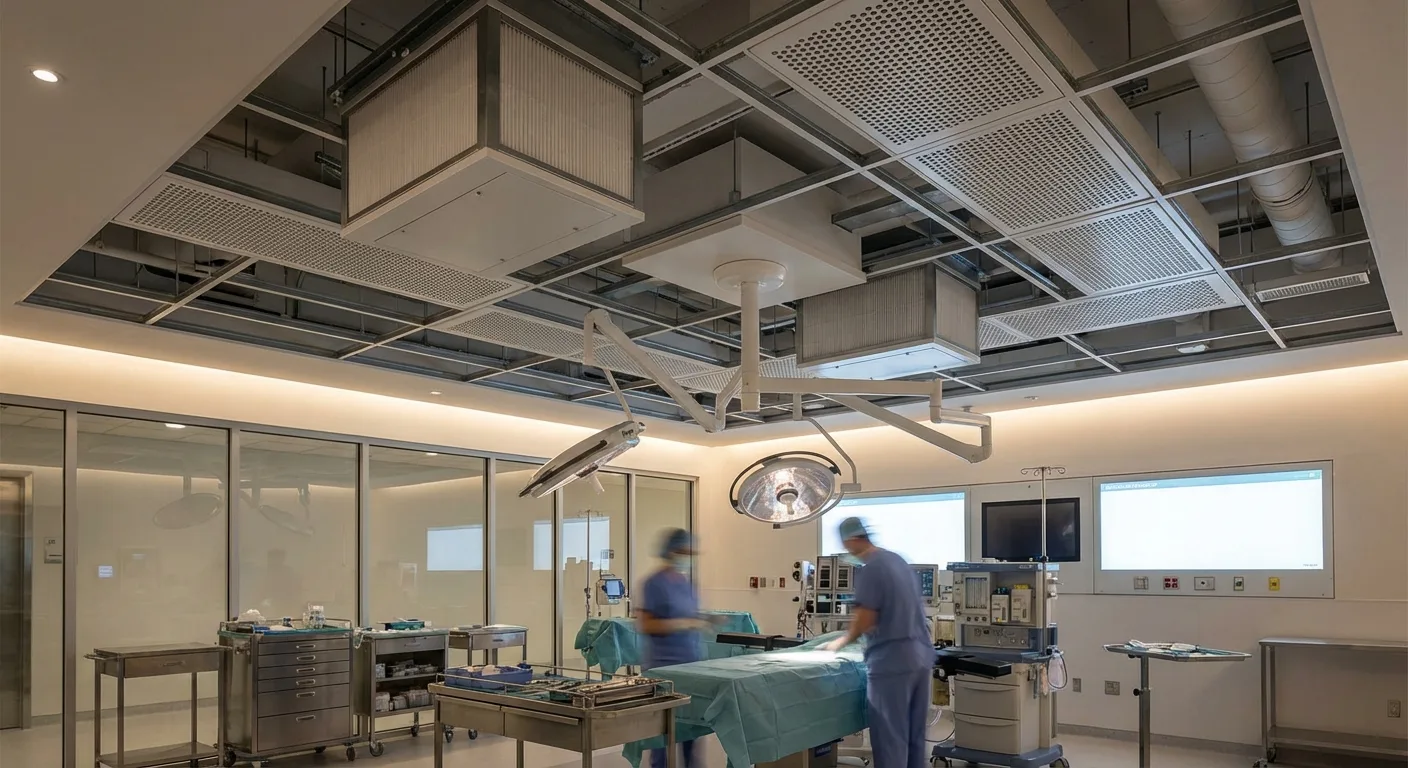
HVAC systems in healthcare facilities must not only provide comfortable environments but also fulfill the critical mission of infection control. Specialized medical spaces such as operating rooms, intensive care units, and isolation rooms have stringent regulatory requirements for air change rates, pressure differentials, temperature and humidity, and air filtration. Based on ASHRAE Standard 170 and FGI Guidelines, we design HVAC systems for healthcare institutions that meet infection control standards.
Design Process
- Healthcare Space Classification and Requirements Assessment -- Classify medical spaces according to ASHRAE 170[1], and determine air change rates, pressure differential direction, temperature and humidity requirements, and filtration levels for each space.
- HVAC System Planning -- Design independent or zoned HVAC systems based on the requirements of each space, planning outside air handling, cooling and heating, filtration, and supply/return air paths.
- Pressure Differential Control Design -- Establish pressure gradient relationships between spaces, design supply and exhaust air volume balancing and pressure control strategies to ensure protective (positive pressure) or isolation (negative pressure) environments[1].
- Air Filtration System -- Plan a multi-stage filtration architecture with HEPA filters (99.97% or greater at 0.3 micrometers) at operating room terminals, and appropriate MERV-rated filters for general areas as required by ASHRAE 170.
- Construction Supervision -- Ensure construction quality meets healthcare-grade requirements, including duct sealing, equipment cleanliness, and system disinfection procedures.
- Validation and Commissioning -- Perform airflow measurements, pressure differential verification, particle counting, and temperature/humidity confirmation, and issue comprehensive validation reports.
Technical Standards and Specifications
- ASHRAE Standard 170 -- Ventilation standard for healthcare facilities, specifying minimum air change rates, outside air ratios, pressure differential directions, temperature and humidity ranges, and filtration levels for various healthcare spaces[1].
- ASHRAE Standard 62.1 -- Ventilation standard for commercial buildings, serving as a supplementary ventilation design reference for general areas within healthcare facilities[2].
- FGI Guidelines -- Facility Guidelines Institute guidelines for healthcare facility construction, providing comprehensive guidance for healthcare building design, with HVAC chapters extensively referencing ASHRAE 170[3].
- NFPA 99 -- Health Care Facilities Code, specifying fire protection requirements for medical gas systems, electrical safety, and HVAC systems[4].
Key Design Considerations
Operating Room HVAC Design
ASHRAE 170 requires operating rooms to maintain positive pressure (at least +2.5 Pa relative to the corridor), a minimum total air change rate of 20 ACH, with at least 4 ACH of outside air[1]. Supply air typically uses a ceiling-mounted laminar airflow diffuser to create unidirectional downward airflow above the surgical table, carrying particles away from the sterile field. Temperature is controlled within 20-24°C with 20-60% relative humidity. Condensation prevention is another important consideration -- any condensation on piping or equipment surfaces can become a breeding ground for microorganisms.
Isolation Room Pressure Control
Airborne Infection Isolation (AII) rooms require negative pressure design (at least -2.5 Pa relative to the corridor), a minimum total air change rate of 12 ACH, with all exhaust air HEPA-filtered before discharge[1]. Protective Environments (PE) require positive pressure with a minimum of 12 ACH and HEPA-filtered supply air. Some rooms require combined AII and PE functionality (AII/PE), utilizing a vestibule design with dual-layer pressure control. The stability and reliability of pressure differentials represent the greatest design challenge.
Redundancy and Reliability
Healthcare HVAC systems must operate without interruption. HVAC systems for critical areas (operating rooms, ICU, isolation rooms) require N+1 redundancy and connection to emergency power systems. NFPA 99 has explicit requirements for the reliability of mechanical and electrical systems in healthcare facilities[4], which must be incorporated into the HVAC system design.
Our Advantages
Healthcare facility HVAC is one of the most complex domains among all building HVAC types, as it simultaneously involves comfort, infection control, regulatory compliance, and system reliability requirements. Our team has extensive practical experience in healthcare facility HVAC design, with thorough knowledge of all ASHRAE 170 requirements, enabling us to balance system energy efficiency and maintenance convenience while meeting infection control standards.
Specialized Healthcare Space Design
Operating Room HVAC
The operating room has the most stringent HVAC requirements in any healthcare facility. Per ASHRAE Standard 170, the air change rate must not be less than 20 ACH, with a minimum fresh air ratio of 4 ACH. The supply air method uses a ceiling-mounted laminar flow canopy design that creates unidirectional downward airflow in the surgical zone, rapidly carrying away particles and microorganisms generated during surgery from the sterile field. The operating room must maintain a positive pressure differential of at least +2.5 Pa relative to adjacent areas to prevent contaminated air from corridors or preparation areas from entering. Temperature is typically set at 20-24°C, relative humidity at 30-60% RH, and an adjustable temperature setting range must be provided for the surgeon.
Isolation Rooms (Negative Pressure Rooms)
Airborne Infection Isolation (AII) rooms must maintain a negative pressure differential of at least -2.5 Pa relative to the corridor, with an air change rate of no less than 12 ACH (new construction) or 6 ACH (existing buildings). Exhaust air must be HEPA-filtered (efficiency of 99.97% or greater at 0.3 micrometers) before discharge to the outdoors. Access management (vestibule/airlock design), continuous pressure differential monitoring and alarm systems, and exhaust duct sealing integrity are design details that cannot be overlooked. Following the COVID-19 pandemic, many hospitals have increased their need for negative pressure isolation rooms, and we have extensive experience in both renovation and new construction projects.
Pharmacy and Sterile Compounding Rooms
Sterile compounding rooms in hospital pharmacies (such as chemotherapy drug preparation areas) must meet USP 797/800 environmental requirements, including appropriate cleanliness levels (ISO Class 5 to Class 7), pressure differential control (hazardous drug compounding areas must be negative pressure), and temperature and humidity control. The integration of biological safety cabinet (BSC) exhaust design with the HVAC system is a key design focus.
Infection Control and Air Quality
The HVAC system in healthcare facilities is a critical line of defense for infection control. In our designs, we pay special attention to zone-specific air filtration levels (MERV 14 for general areas, HEPA for operating rooms), separation of return air and exhaust air ductwork (to prevent cross-contamination), and independent HVAC circuit design for specialized areas (such as tuberculosis wards and burn wards). Well-designed HVAC systems not only protect patients but also safeguard the occupational health and safety of healthcare workers.