
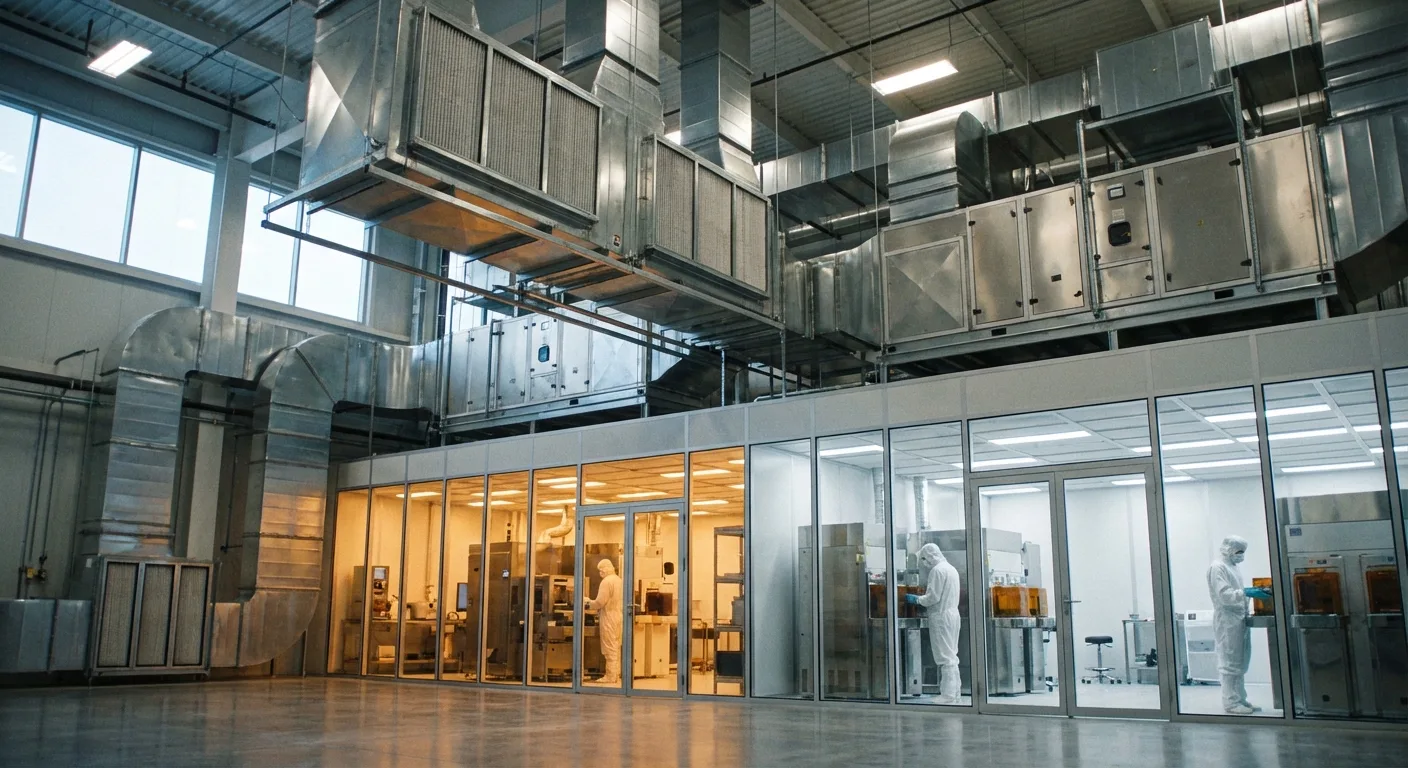
Industrial process HVAC is fundamentally different from general comfort air conditioning -- its design must prioritize the strict requirements of production processes for temperature, humidity, cleanliness, and ventilation/exhaust, while also ensuring the safety and health of workers. Based on ASHRAE standards and the ACGIH Industrial Ventilation Manual, we provide professional factory HVAC and ventilation system design for electronics, chemical, textile, food processing, and other manufacturing industries.
Design Process
- Process Environment Requirements Survey -- Gain thorough understanding of production process characteristics, environmental condition requirements (temperature, humidity, cleanliness), types and emission rates of hazardous substances, and worker distribution.
- Ventilation Rate Calculation and System Planning -- Calculate dilution ventilation and local exhaust airflow requirements based on ASHRAE 62.1 and the ACGIH Industrial Ventilation Manual[1][2], and plan supply/exhaust system configurations.
- HVAC Load Calculation -- Analyze process equipment heat dissipation, occupant heat, lighting loads, and outside air loads to calculate cooling and dehumidification requirements. Internal heat generation loads in industrial facilities often far exceed envelope loads.
- Exhaust and Air Treatment Design -- Design local exhaust hood types, duct routing, air velocities, and air purification devices (scrubbers, activated carbon adsorption, HEPA, etc.) based on hazardous substance characteristics, ensuring emissions comply with environmental regulations.
- Construction Supervision and Performance Verification -- Supervise construction quality and complete system airflow measurement and balancing tests, verifying ventilation system performance in accordance with ASHRAE 111[3].
Technical Standards and Specifications
- ASHRAE Standard 62.1 -- Ventilation standard for commercial buildings, applicable to ventilation design for office areas and general work spaces within industrial facilities[1].
- ASHRAE Standard 111 -- HVAC system measurement, testing, adjusting, and balancing (TAB) standard, used to verify the design performance of industrial ventilation systems[3].
- ACGIH Industrial Ventilation Manual -- The practical industrial ventilation handbook published by the American Conference of Governmental Industrial Hygienists, providing detailed guidance on exhaust hood design for various processes, duct velocities, capture velocities, and more[2].
Key Design Considerations
Local Exhaust vs. Dilution Ventilation
There are two fundamental strategies for controlling hazardous substances in industrial facilities: Local Exhaust Ventilation (LEV) and dilution ventilation. The ACGIH manual recommends prioritizing local exhaust ventilation[2], which captures and removes contaminants at the source for maximum efficiency with minimum airflow requirements. Dilution ventilation is suitable for situations where hazardous substances have low toxicity, small emission rates, and are dispersed. In practice, both strategies are often used in combination.
Process Temperature and Humidity Control
Electronics manufacturing processes are extremely sensitive to temperature and humidity: SMT (Surface Mount Technology) processes require 25 plus or minus 2°C and 50 plus or minus 10% RH to prevent solder paste moisture absorption; textile spinning workshops need to maintain 28-32°C and 65-75% RH to ensure fiber spinnability; the printing industry has strict humidity control requirements to prevent static electricity and paper deformation. These process requirements determine the control precision and design complexity of the HVAC system.
Heat Dissipation Strategies for High-Temperature Facilities
Heat dissipation in high-temperature process facilities such as foundries, heat treatment plants, and glass processing plants presents significant engineering challenges. Large amounts of radiant and convective heat must be managed through strategies including high-volume ventilation, evaporative cooling, and spot cooling. The design focus is on ensuring the thermal environment for workers complies with safety regulations while keeping energy consumption within reasonable limits.
Our Advantages
Industrial process HVAC design requires deep understanding of the process characteristics and environmental requirements of each industry. Our team has accumulated extensive experience in factory HVAC design across electronics, food processing, chemical, and other industry types, enabling us to accurately identify process environment requirements and propose HVAC and ventilation solutions that balance production quality, worker safety, and operational costs.
Industry Applications
Electronics Manufacturing Process Environment
Electronic component manufacturing is extremely sensitive to environmental temperature and humidity. PCB printed circuit board printing and etching processes require stable temperature and humidity control (typically 23 plus or minus 2°C, 50 plus or minus 5% RH) to ensure circuit precision. In SMT surface mount processes, the temperature in solder paste printing areas must be controlled within 25 plus or minus 1°C to prevent solder paste viscosity changes from affecting print quality. We plan zone-controlled HVAC systems based on the environmental requirements of each process station, maximizing energy efficiency while meeting quality requirements.
Chemical Industry Ventilation and Exhaust
HVAC and ventilation design for chemical plants must simultaneously address worker safety and process requirements. Following the design principles of the ACGIH Industrial Ventilation Manual, local exhaust systems for organic solvent use areas (such as exterior exhaust hoods and downdraft ventilation) must ensure that hazardous substance concentrations at workers' breathing zones remain below Permissible Exposure Limits (PEL). General ventilation air change calculations must consider solvent evaporation rates, space volume, and dilution ratios. Explosion-proof design of exhaust systems (including explosion-proof ratings for fans, electrical equipment, and duct materials) is a safety requirement that cannot be overlooked in chemical plant ventilation design.
Textile Industry Temperature and Humidity Control
The humidification requirements of the textile industry differ significantly from general HVAC. Spinning processes require higher relative humidity (65%-75% RH) to reduce yarn breakage rates, while weaving processes need 70%-80% RH to minimize static electricity generation. HVAC systems in high-humidity environments require special attention to condensate management, anti-mold treatment on duct interior surfaces, and water quality control for humidification equipment (to prevent Legionella and other microbial growth). We employ dry steam humidification or high-pressure micro-mist humidification methods to achieve target humidity levels while ensuring hygiene and safety.
Environmental Compliance and Regulations
Industrial HVAC and ventilation system design must comply with environmental regulations governing emissions. Exhaust gases must undergo appropriate treatment before discharge (such as activated carbon adsorption, scrubbers, catalytic oxidation, etc.) to bring emission concentrations into compliance with stationary source air pollutant emission standards. We incorporate environmental regulatory requirements at the system design stage, planning appropriate exhaust gas treatment equipment and emission monitoring facilities to help clients pass environmental impact assessments and obtain operating permits.