
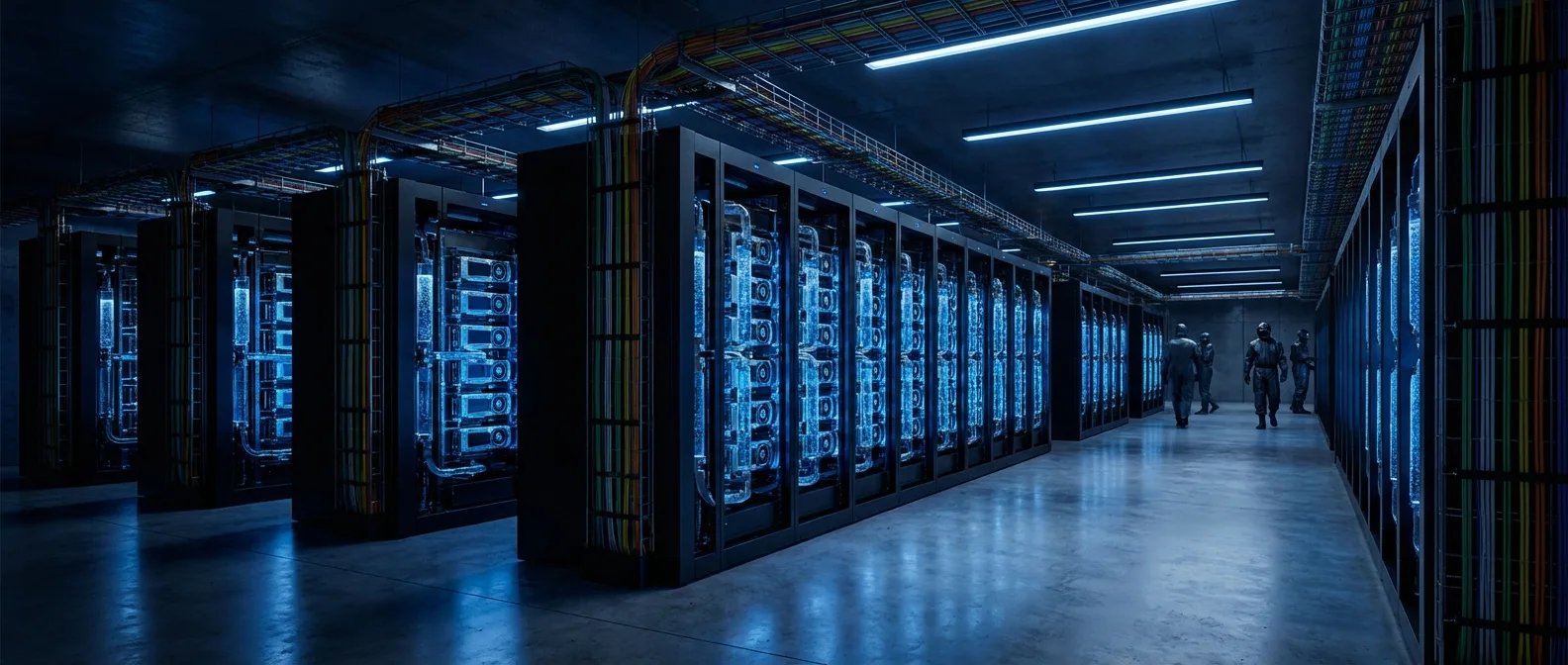
The AI computing era has fundamentally redefined data center cooling requirements. Traditional server racks have power densities of approximately 5-10 kW, while GPU high-density computing racks can reach 40-100 kW or even higher — far exceeding the cooling capacity of conventional air cooling systems. Based on the thermal environment guidelines from ASHRAE TC 9.9, we design high-performance cooling systems for AI compute centers.
Design Process
- IT Load & Cooling Demand Analysis — Determine GPU server specifications, rack power density, total facility IT load, and future expansion plans to calculate total cooling requirements.
- Cooling Solution Evaluation & Selection — Based on rack power density, evaluate the suitability of air cooling, in-row cooling, rear-door heat exchangers (RDHx), direct liquid cooling (DLC), or immersion cooling[1].
- Hot/Cold Aisle Containment Design — Plan cold aisle containment (CAC) or hot aisle containment (HAC) strategies to improve airflow management efficiency[2].
- Cooling Plant Design — Design chillers, cooling towers, and free cooling systems, optimizing PUE in accordance with ASHRAE 90.4[3].
- Redundancy & Reliability Planning — Plan N+1 or 2N cooling redundancy based on facility tier classification (Tier I-IV) to ensure uninterrupted cooling system operation.
- Monitoring & Management System Integration — Deploy Data Center Infrastructure Management (DCIM) systems for real-time monitoring of key parameters including rack inlet temperature, return air temperature, cooling water temperature, and flow rates.
Technical Standards & Specifications
- ASHRAE TC 9.9 Thermal Guidelines — Defines recommended inlet temperature ranges for data center IT equipment (A1 class: 18-27 degrees C) and allowable ranges (15-32 degrees C), as well as humidity recommendations[2].
- ASHRAE Standard 90.4 — Data center energy efficiency standard specifying minimum cooling system efficiency requirements, with PUE (Power Usage Effectiveness) as the core metric[3].
- ASHRAE Liquid Cooling Guidelines — Liquid cooling system design guidelines covering Direct Liquid Cooling (DLC) and Immersion Cooling design principles[1].
Core Design Considerations
Limits & Breakthroughs of Air Cooling Systems
Traditional precision air conditioning with raised floor underfloor air distribution encounters cooling bottlenecks when rack power density exceeds 15-20 kW. Hot/cold aisle containment can extend air cooling system capacity to approximately 25-30 kW per rack[2]. In-row cooling units installed directly between rack rows shorten the cooling path and can support higher power densities. However, for GPU racks exceeding 40 kW, liquid cooling has become a necessary solution.
Liquid Cooling Engineering Practice
Direct Liquid Cooling (DLC) uses cold plates attached directly to CPU/GPU chips to carry away waste heat, achieving far superior cooling efficiency compared to air cooling. The coolant is typically deionized water or specialized cooling fluid, with supply temperatures of 35-45 degrees C that facilitate free cooling and reduce cooling plant energy consumption. Immersion cooling submerges entire servers in non-conductive coolant for maximum cooling efficiency, but fundamentally changes facility design and maintenance practices.
PUE Optimization Strategies
ASHRAE 90.4 uses PUE as the core metric for data center energy efficiency[3]. Key strategies for reducing PUE include: raising chilled water supply temperature to increase free cooling hours, employing variable frequency drives for pumps and fans, optimizing cooling tower approach temperature, and using AI algorithms to dynamically adjust cooling system operating parameters. Modern high-efficiency data centers typically target PUE values of 1.2-1.3 or lower.
Our Advantages
HVAC design for AI compute centers represents a comprehensive upgrade from traditional data center engineering. From conventional air cooling to the adoption of liquid cooling technologies, from single-facility design to campus-scale cooling plant planning, every aspect demands deep engineering expertise and command of emerging technology trends. Our team combines nearly half a century of refrigeration and air conditioning engineering experience with ongoing research into next-generation cooling technologies, delivering design solutions that are both reliable and forward-looking.
Cooling Technology Comparison
Traditional Air Cooling
Traditional air cooling systems use precision air conditioning units (CRAC/CRAH) with raised floor underfloor supply or overhead supply, suitable for traditional data centers with per-rack power consumption under 10kW. The advantages of air cooling lie in system maturity, ease of maintenance, and complete decoupling from IT equipment. However, as AI computing drives per-rack power consumption beyond 30kW or even 100kW, pure air cooling solutions can no longer meet cooling demands — air's specific heat capacity (1.005 kJ/kg K) is far lower than water's (4.186 kJ/kg K), requiring extremely high airflow volumes for equivalent cooling capacity, leading to severe noise issues and significantly reduced energy efficiency.
Direct Liquid Cooling
Direct Liquid Cooling (DLC) technology channels coolant directly to cold plates on GPU chip surfaces for maximum cooling efficiency. Current mainstream DLC solutions include single-phase liquid cooling (using deionized water or propylene glycol solutions) and two-phase liquid cooling (using low-boiling-point working fluids such as the 3M Novec series). Single-phase liquid cooling technology is already quite mature — NVIDIA's DGX series servers all support cold plate liquid cooling configurations, capable of handling over 100kW per rack of cooling demand. Our team has developed comprehensive engineering capabilities in liquid cooling piping design, Coolant Distribution Unit (CDU) selection, and system leak prevention planning.
Immersion Cooling
Immersion Cooling submerges entire servers in non-conductive coolant, achieving comprehensive heat dissipation. This approach can completely eliminate fan noise, dramatically reduce PUE values (achievable at 1.03-1.05), and offers maximum flexibility in IT equipment layout. However, immersion cooling currently faces challenges including high coolant costs, maintenance inconvenience, and compatibility issues with certain IT equipment. We continue to track the development of this technology and provide clients with forward-looking technical recommendations.
Power & Cooling Co-Planning
The power and cooling systems of an AI compute center are inseparable. For every 1kW of IT power consumed, the cooling system requires approximately 0.2-0.5kW of auxiliary power (depending on PUE). Power capacity, distribution architecture, UPS systems, and cooling systems must be considered holistically from the planning stage to prevent any single element from becoming a bottleneck. We work closely with electrical engineering teams, providing integrated engineering design services from overall power planning through rack-level power distribution and cooling solutions.