
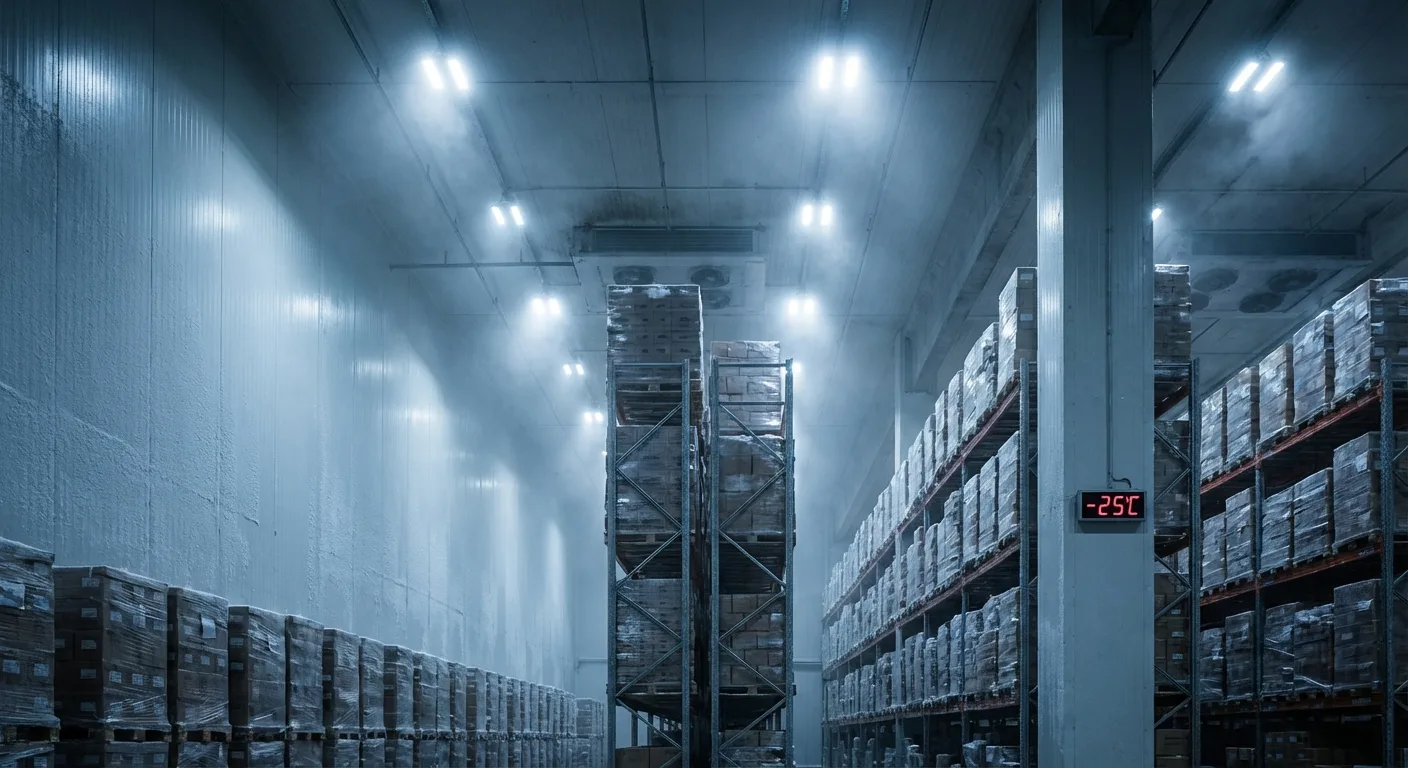
Large-scale cold storage is the core infrastructure of the food supply chain and cold chain logistics. From rapid freezing at -25°C to refrigerated preservation at +5°C, the design of each temperature zone directly impacts food safety and operational costs. Based on the ASHRAE Handbook -- Refrigeration and IIAR standards, we provide comprehensive cold storage engineering design services covering refrigeration load calculation, insulation design, refrigeration system configuration, and automated temperature control.
Design Process
- Storage Requirements and Temperature Zone Planning -- Based on the types of products stored, loading/unloading frequency, and storage capacity requirements, we plan the configuration of each temperature zone (blast freezing, frozen storage, refrigerated storage, vestibule, etc.) and spatial dimensions.
- Refrigeration Load Calculation -- Following the methodology described in the ASHRAE Handbook -- Refrigeration[1], we calculate conduction loads, product loads, infiltration loads, equipment heat dissipation, and other load components, with appropriate safety margins applied.
- Insulation Design -- We select insulation materials (polyurethane PUR/PIR foam panels), calculate insulation thickness, and design vapor barriers and floor anti-heave heating systems to prevent foundation frost heave.
- Refrigeration System Configuration -- Based on refrigeration capacity and refrigerant selection (NH3 ammonia, CO2, HFC, etc.), we design compressor units, condensers, evaporators, and associated piping systems in compliance with ASHRAE 15 refrigerant safety standards[2].
- Automated Control System -- We plan temperature monitoring, defrost control, compressor group control, and alarm systems to achieve automated operation management.
- Construction Supervision and Commissioning -- We supervise construction quality for the enclosure, equipment installation, piping welding, and system charging, then complete cool-down testing and performance verification.
Technical Standards and Specifications
- ASHRAE Standard 15 -- Refrigeration system safety standard specifying refrigerant charge limits, machinery room ventilation, leak detection, and safety protection requirements[2].
- ASHRAE Standard 34 -- Refrigerant designation and safety classification standard, categorizing refrigerants by toxicity and flammability into six safety groups from A1 to B3[3].
- ASHRAE Handbook -- Refrigeration -- Chapters 23 (Refrigerated-Facility Design) and 24 (Refrigerated-Facility Loads) provide comprehensive guidance on cold storage design and load calculation[1].
- IIAR Standards -- Standards published by the International Institute of Ammonia Refrigeration for ammonia system design, installation, and maintenance[4].
Key Design Considerations
Insulation and Anti-Heave Design
The insulation of a cold storage enclosure is the critical factor determining operational energy consumption. The thermal resistance (R-value) of the insulation layer must be sufficient to keep conduction loads within a reasonable range. For a -25°C cold storage facility, insulation panel thickness typically needs to be 150--200 mm or more (PUR/PIR, lambda approximately 0.022--0.024 W/m*K)[1]. The floor section requires anti-heave heating pipes or a ventilated air space beneath to prevent soil freezing and frost heave of the foundation.
Refrigerant System Safety and Efficiency
Large cold storage systems commonly use ammonia (R-717) as the refrigerant, which offers excellent thermodynamic performance and is environmentally friendly (ODP=0, GWP=0), but is toxic and mildly flammable, classified as B2L under ASHRAE 34[3]. Ammonia system design must strictly comply with the safety requirements of ASHRAE 15 and IIAR standards[2][4], including machinery room ventilation, ammonia leak detection, emergency discharge, and personal protective equipment. In recent years, CO2 (R-744) transcritical systems and NH3/CO2 cascade systems have also become mainstream alternatives.
Defrost Strategy and Energy Management
Frost buildup on evaporators reduces heat exchange efficiency, while the defrost process temporarily raises the storage temperature. Defrost methods include electric heating defrost, hot gas defrost, and water defrost, each with its own advantages and disadvantages. Proper defrost scheduling and defrost termination control are critical considerations for maintaining stable cold storage temperatures and controlling energy consumption.
Our Advantages
Cold storage engineering is a core specialty in the field of refrigeration and air conditioning. From small food factory cold/frozen storage rooms to large-scale automated cold storage distribution centers, our team possesses comprehensive design capabilities and construction supervision experience. With professional licensure as a refrigeration and air conditioning engineer, we ensure that every cold storage facility is designed in compliance with international standards and local regulations, delivering safe, efficient, and cost-effective refrigeration facilities for our clients.
Temperature Classification and Design Highlights
High-Temperature Cold Storage (0°C to 10°C)
High-temperature cold storage is primarily used for fruits, vegetables, flowers, dairy products, and other products that require low-temperature preservation without freezing. The design focus is on temperature uniformity control -- the temperature variation at any point within the storage should not exceed plus or minus 1°C to prevent product damage from localized overcooling. Evaporator selection must consider defrost frequency and method (electric or hot gas defrost), as well as temperature fluctuation control during defrost cycles. Air distribution typically employs a ceiling return-air design to ensure uniform cold air distribution across all shelf levels.
Low-Temperature Frozen Storage (-18°C to -25°C)
The standard temperature for general frozen food storage is -18°C, while certain premium seafood or ice cream products require a -25°C storage environment. The critical design element for low-temperature frozen storage is insulation -- using polyurethane (PU) foam panels as an example, at -25°C operating conditions, insulation panel thickness typically needs to be 150 mm to 200 mm, and panel joint airtightness must be ensured to prevent thermal bridging that causes condensation and energy loss. The anti-heave system for the floor is a critical element often overlooked in low-temperature storage design. We employ floor heating pipes or ventilated duct trenches to prevent soil frost heave damage to the building structure.
Ultra-Low Temperature Storage (-35°C to -60°C)
Ultra-low temperature cold storage is used for tuna (-55°C to -60°C), pharmaceuticals, specialty chemicals, and other applications requiring extremely low temperature environments. These facilities typically use cascade refrigeration systems, with two independent circuits using different refrigerants connected in series to achieve lower evaporation temperatures. Equipment material selection at ultra-low temperatures is critical -- standard carbon steel undergoes brittle fracture below -40°C and must be replaced with low-temperature steel or stainless steel materials.
Automation and Monitoring
Modern cold storage management has evolved from manual inspection to fully automated monitoring. Our monitoring systems encompass real-time temperature monitoring (multi-point temperature sensor deployment), compressor operating status monitoring, evaporator frost detection with automated defrost scheduling, abnormal temperature alarms with remote notification, and historical data logging with energy consumption analysis. A comprehensive monitoring system not only ensures storage quality but is also a prerequisite for food safety certifications such as HACCP and ISO 22000.