
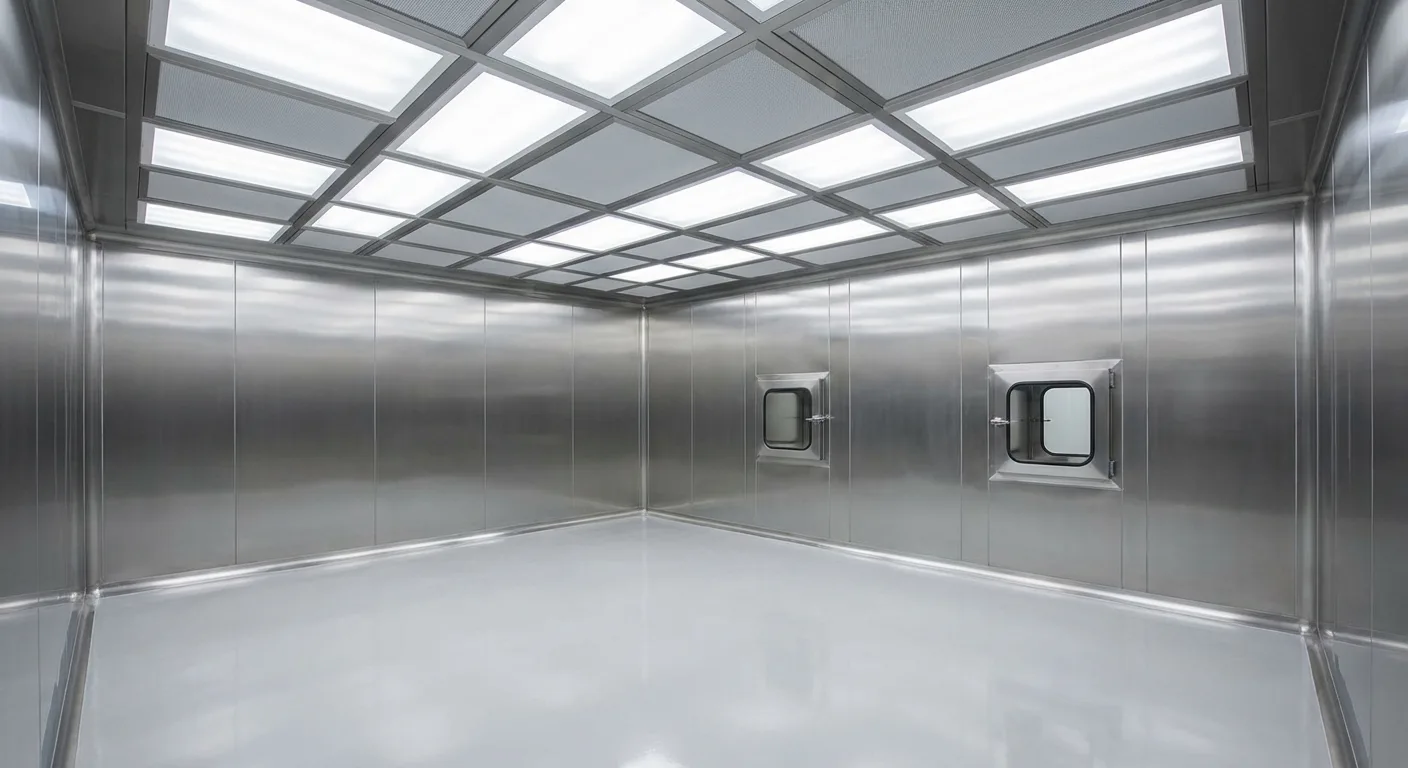
Cleanrooms are the core infrastructure for the semiconductor, optoelectronics, pharmaceutical, and biotechnology industries. The precise control of airborne particle concentration, temperature, humidity, pressure differentials, and airflow patterns directly affects product yield and process quality. Based on the ISO 14644 series standards and relevant ASHRAE specifications, we provide comprehensive cleanroom HVAC engineering services — from cleanliness classification planning through verification testing.
Design Process
- Cleanliness Classification Confirmation — Determine the target cleanliness level (ISO Class 1-9) based on product process requirements as the foundation for HVAC system design[1].
- Airflow Pattern Planning — Select unidirectional or non-unidirectional airflow patterns based on cleanliness requirements. Plan FFU coverage ratio, supply air velocity, and return air paths[2].
- Filtration System Design — Select pre-filters according to ASHRAE 52.2, with terminal HEPA/ULPA filters, establishing a multi-stage filtration architecture[3].
- Pressure Differential & Environmental Control Planning — Design pressure gradients between zones, temperature and humidity control precision, as well as airlock and door interlock control schemes.
- Construction Supervision & Commissioning — Quality management during construction, ensuring duct sealing integrity, filter installation completeness, and system cleanliness.
- Verification Testing — Perform particle count verification in as-built, at-rest, and operational states according to ISO 14644-3 to confirm system performance compliance[4].
Technical Standards & Specifications
- ISO 14644-1:2015 — Classification standard based on airborne particle concentration, defining nine levels from ISO Class 1 to Class 9[1].
- ISO 14644-4:2001 — Cleanroom design, construction, and start-up guidelines covering airflow patterns, pressure differential control, material selection, and other design considerations[2].
- ASHRAE Standard 52.2 — Air filter efficiency testing method standard (MERV classification) for pre-filter performance evaluation and selection[3].
- ASHRAE Standard 129 — Method for measuring air distribution effectiveness in enclosed spaces, used to evaluate supply air uniformity in cleanrooms[5].
Core Design Considerations
Balancing Cleanliness & Energy Consumption
Higher cleanliness requirements demand greater air supply volumes, higher-grade filters, and stricter pressure differential control — all of which directly translate into energy costs. An ISO Class 5 cleanroom may require 240-480 air changes per hour, while ISO Class 7 requires only 60-90. Setting appropriate cleanliness targets and applying tiered design for different process areas are key to controlling both initial investment and operating energy costs.
Airflow Field Simulation & Optimization
In complex cleanroom environments, the layout of process equipment significantly impacts airflow fields. Using CFD (Computational Fluid Dynamics) simulation and analysis, we predict airflow disturbances caused by equipment placement, optimize supply and return air outlet configurations, and ensure particles are effectively carried away from clean zones.
Environmental Monitoring System Integration
A Continuous Monitoring System (CMS) is the foundation for ensuring long-term stable cleanroom operation. Monitoring parameters include particle concentration, temperature, humidity, pressure differentials, and air velocity. Combined with historical data analysis and trend-based early warnings, it provides comprehensive environmental management information.
Our Advantages
Our team possesses extensive practical design experience in cleanroom engineering, from ISO Class 5 process cleanrooms for the electronics industry to GMP clean facilities for the pharmaceutical industry. We deliver professional design solutions that meet international standards and industry regulatory requirements. Drawing on nearly half a century of HVAC engineering experience, we understand that cleanroom design is not merely about achieving cleanliness numbers — it is about finding the optimal balance among system reliability, maintainability, and operating costs.
Cleanliness Classifications & Applications
Semiconductor & Electronics Industry
Semiconductor manufacturing demands extremely stringent particle control. Advanced process lithography bays typically require ISO Class 3 to Class 4 cleanliness, equivalent to no more than 1,000 particles of 0.1 um or larger per cubic meter of air. This requires a large number of FFUs (Fan Filter Units) with ULPA filters (Ultra-Low Penetration Air Filter, filtration efficiency of 99.9995% or higher) and rigorous airflow pattern management — typically employing full unidirectional airflow design to ensure particles are rapidly swept away from work areas.
Pharmaceutical & Biotechnology Industry
Cleanroom design for the pharmaceutical industry requires attention not only to particle control but also to the prevention of microbial contamination. Per the PIC/S GMP Annex 1 guidelines, sterile process areas must achieve Grade A (equivalent to ISO Class 5 at rest) environmental conditions, equipped with comprehensive temperature/humidity control, pressure differential monitoring, and environmental surveillance systems. Our designs place special emphasis on airlock design and pressure cascade planning between zones of different cleanliness grades to prevent cross-contamination.
Food Processing Industry
Cleanroom design for food processing environments focuses on preventing product contamination from microorganisms and foreign matter. While cleanliness requirements are typically ISO Class 7 to Class 8, additional considerations include dehumidification control in low-temperature environments (such as refrigerated processing areas at 0-5 degrees C), condensation prevention, and drainage design. We integrate Critical Control Points (CCPs) into the HVAC and cleanroom design following HACCP principles.
Verification & Maintenance
Cleanroom engineering quality depends not only on design and construction but also on rigorous qualification and ongoing maintenance management. Following ISO 14644-3 specifications, we assist clients in executing three-phase testing — as-built, at-rest, and operational qualification — to confirm that key parameters including particle concentration, air velocity, pressure differentials, temperature/humidity, and recovery time all meet design specifications. We also provide comprehensive re-qualification plans to ensure long-term stable cleanroom operation.