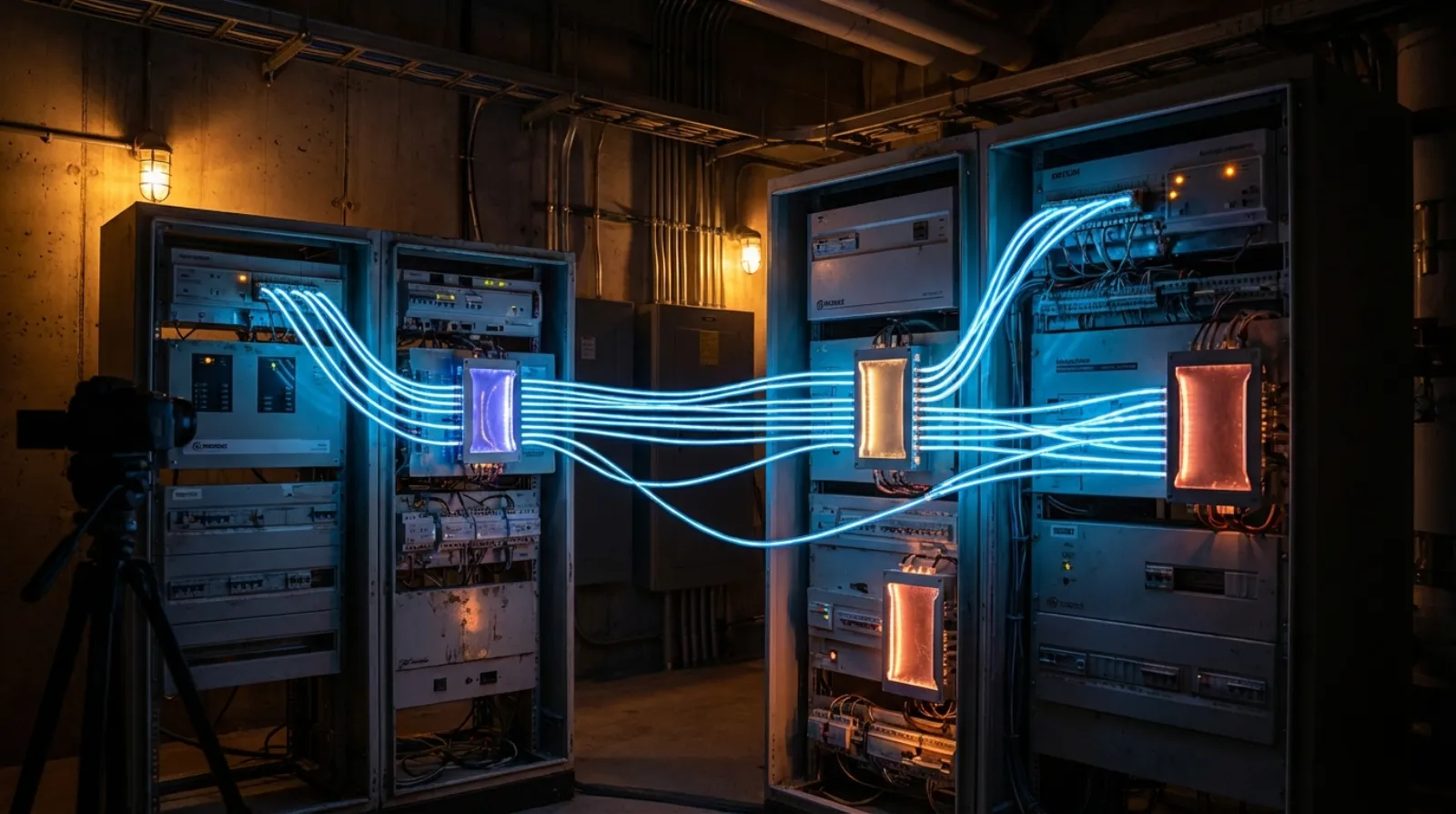
The building automation industry faces a structural contradiction: buildings have a lifespan of 50-80 years, but control system technology cycles are only 10-15 years. When an owner installed Siemens Desigo CC in 2010, switched to Johnson Controls Metasys during a 2018 expansion, and added Schneider EcoStruxure energy management modules in 2024, the predicament of three siloed systems with incompatible data formats becomes the norm[1]. The Model Context Protocol (MCP) open standard published by Anthropic in November 2024[2], while originally designed for AI model integration with external tools, has an architectural logic -- a universal data access layer connecting heterogeneous systems -- that directly addresses the decades-old interoperability challenge in building automation. This article explores how the MCP protocol opens new integration paradigms for smart building management from an HVAC engineering perspective.
1. Vendor Lock-In: The Structural Dilemma of Building Automation
The global Building Automation System (BAS) market has long been dominated by four major vendors: Siemens' Desigo CC, Johnson Controls' Metasys, Honeywell's Niagara Framework, and Schneider Electric's EcoStruxure Building[1]. Each vendor has developed a complete ecosystem -- from field controllers, communication protocols, to supervisory software -- forming highly vertically integrated closed architectures.
The Cost of Vendor Lock-In
Vendor lock-in imposes multi-layered costs on building owners. First is procurement cost: once a building has deployed a specific vendor's controllers and communication infrastructure, subsequent expansions and maintenance are virtually limited to the same vendor's products, stripping owners of market bargaining power. Second is integration cost: when different zones or systems (HVAC, lighting, power monitoring) use different vendors' controllers, system integration requires middleware or gateways for protocol translation, with each translation node adding cost, latency, and failure points.
According to ASHRAE technical reports, in a typical 50,000 square meter commercial office building, the lifecycle integration cost of BAS systems can reach 150-200% of the initial installation cost[3]. Cross-vendor integration engineering fees are often the largest hidden expense.
Data Silos and Energy Management Challenges
A deeper issue caused by vendor lock-in is data silos. A modern building may have thousands of sensing points -- temperature, humidity, CO2 concentration, chilled water flow, electrical load -- but this data is scattered across different vendors' controllers, using different data models and naming conventions. The chilled water supply temperature might be labeled "CHW_Supply_Temp" in a Siemens system, "CW_ST" in a Honeywell system, and "ChilledWater.Supply.Temperature" in a Schneider system. This semantic inconsistency makes automated cross-system energy analysis and optimization virtually impossible.
2. Traditional Protocols: Interoperability Challenges of BACnet, Modbus & LonWorks
The building automation industry has not been without attempts to establish open standards. Over the past thirty years, the industry has developed multiple communication protocols to address device interoperability.
BACnet (ASHRAE Standard 135)
BACnet is currently the most widely adopted open protocol in building automation, established by ASHRAE as ANSI/ASHRAE Standard 135 in 1995 and adopted as ISO 16484-5 international standard in 2003[4]. BACnet defines data communication specifications between building control devices, covering object models, services, and network layers. Its object model abstracts building control elements into standard object types such as Analog Input, Analog Output, and Binary Value, with each object having standard properties like Present Value and Status Flags.
However, BACnet's actual interoperability falls far short of what the standard documents describe. First, BACnet allows vendors to define proprietary objects and proprietary properties, which vendors use extensively for differentiated features, meaning BACnet device "interoperability" is often limited to basic read/write operations while advanced functions still require vendor-specific software. Second, BACnet's object naming lacks semantic constraints -- the same Analog Input object may have completely different Description and Object Name fields across vendors, making it impossible for machines to automatically understand its physical meaning[5].
Modbus & LonWorks
Modbus is one of the oldest communication protocols in industrial automation, developed by Modicon (now Schneider Electric) in 1979. Its simple register read/write architecture has made it widely adopted in HVAC equipment (chillers, air handling units, variable frequency drives), but Modbus lacks object models and semantic description capabilities -- whether register address 40001 stores temperature or pressure depends entirely on the equipment manufacturer's documentation, with no consistency across different manufacturers' register maps.
LonWorks (developed by Echelon Corporation) and KNX (the European-led building automation standard) have certain market shares in specific regions, but translation between them and BACnet still requires dedicated gateways, with each additional protocol interconnection requiring another translation layer, causing system complexity to grow exponentially.
The Fundamental Gap in Semantic Interoperability
The traditional protocols mentioned above solve "communication interoperability" -- devices can exchange data bytes -- but fail to address "semantic interoperability" -- the ability for systems to automatically understand the meaning, context, and relationships of data. This is precisely the gap that semantic tagging frameworks like Project Haystack aim to fill[6].
3. What Is MCP? -- An Open Protocol for AI Tool Integration
The Model Context Protocol (MCP) is an open standard publicly released by Anthropic in November 2024, defining a universal communication protocol between AI models (such as Claude) and external data sources and tools[2]. MCP's core philosophy is: rather than developing custom API integrations for each external system, establish a standardized interface layer that allows AI models to access any MCP-compliant data source in a unified manner.
MCP Technical Architecture
MCP uses a client-server architecture based on JSON-RPC 2.0 message format[2]. Its core components include:
- MCP Host: The application that initiates connections (e.g., Claude Desktop, IDE plugins), responsible for managing connections to multiple MCP Servers
- MCP Client: Runs inside the Host, maintaining a one-to-one stateful session with a single MCP Server
- MCP Server: A lightweight service program that exposes three types of capabilities to Clients through standardized interfaces -- Resources (data resources), Tools (executable operations), and Prompts (preset interaction templates)
MCP's transport layer supports stdio (local inter-process communication) and HTTP+SSE (Server-Sent Events, suitable for remote communication), and allows custom transport protocol extensions. During connection establishment, Client and Server perform capability negotiation to ensure compatibility of supported features[2].
MCP's Structural Correspondence with Building Automation
MCP's architectural logic has a striking structural correspondence with the integration needs of building automation systems. Mapping MCP concepts to the building domain:
| MCP Concept | Building Automation Equivalent | Specific Example |
|---|---|---|
| MCP Host | Building management platform / AI agent | Unified BMS dashboard or AI optimization engine |
| MCP Server | Interface layer for each vendor's BAS system | Siemens Desigo MCP Server, Honeywell Niagara MCP Server |
| Resources | Building sensor data and equipment status | Chilled water supply temperature, AHU operating status, energy consumption data |
| Tools | Equipment control operations | Adjust chiller setpoint, switch AHU operating mode |
| Prompts | Preset O&M query templates | "Query 3rd floor HVAC anomalies", "Generate monthly energy report" |
This correspondence is not coincidental. The problem MCP aims to solve -- enabling AI to access heterogeneous data systems in a unified manner -- is essentially a different expression of the same engineering challenge that building automation has long pursued: cross-vendor interoperability.
4. OpenClaw and the MCP Ecosystem Expansion
MCP's open nature has spawned a rapidly growing developer ecosystem. The OpenClaw project is a major driving force, serving as an open-source registry and discovery platform for MCP Servers, allowing developers to publish, search, and deploy various MCP Servers[7]. As of early 2026, OpenClaw has registered thousands of MCP Servers covering database connections, API integrations, file system operations, IoT device management, and more.
From Software Integration to Physical System Control
The MCP ecosystem expansion is extending from pure software domains to physical system control. Developers have already built MCP Servers for MQTT (IoT communication protocol) and OPC UA (industrial automation communication protocol), which are core communication channels for smart building sensors and controllers. A BAS controller running BACnet/IP communication can publish data to an MQTT Broker through a BACnet-to-MQTT gateway, which is then exposed to AI agents in standardized Resource format by an MQTT MCP Server -- this technical path is entirely feasible today.
OpenClaw's registry mechanism brings critical discoverability to this ecosystem. Imagine a scenario: when a building facility manager searches for "Siemens Desigo BACnet" in their AI assistant, OpenClaw can return the corresponding MCP Server package, and once installed, the AI agent can access Desigo system data -- without developing custom API integration code[7].
5. How AI Agents Bridge Heterogeneous BAS/BMS Systems
MCP's true power lies in enabling AI agents to simultaneously connect to multiple heterogeneous systems and perform cross-system reasoning and operations. This is precisely the most difficult and costly part of traditional BAS integration.
Multi-System Simultaneous Access Architecture
Under the MCP architecture, a single AI agent can simultaneously connect to:
- Siemens Desigo MCP Server -- accessing HVAC system operating data and control points
- Schneider EcoStruxure MCP Server -- accessing power monitoring and energy management data
- Honeywell Niagara MCP Server -- accessing lighting control and security system data
- Weather API MCP Server -- obtaining real-time weather forecasts and historical meteorological data
- Utility API MCP Server -- obtaining real-time electricity pricing and demand response signals
The AI agent obtains data through Resources provided by each MCP Server, uses its language understanding capabilities to automatically parse the semantics of different naming conventions ("CHW_Supply_Temp" and "CW_ST" represent the same physical quantity), and then executes cross-system coordinated operations through Tools. This capability is unmatched by traditional middleware -- traditional middleware relies on pre-defined mapping rules, requiring engineers to manually configure each new device; AI agents can automatically understand the meaning of new data points through contextual reasoning.
Cross-System Optimization Example
Suppose a commercial building's AI agent is simultaneously connected to the HVAC BAS (Siemens) and power monitoring (Schneider). It can execute the following cross-system optimization logic:
- From the Weather MCP Server, learn that the next 4 hours' temperature forecast will continue rising to 35 degrees C
- From the Utility MCP Server, receive peak pricing signals for 2-4 PM
- From the Siemens MCP Server, read the current chilled water system operating load and thermal storage tank capacity
- From the Schneider MCP Server, read real-time power demand for each floor
- After comprehensive assessment, use the Siemens MCP Server's Tools to raise the chiller's current supply water temperature setpoint (pre-cooling before peak hours), while simultaneously using the Schneider MCP Server's Tools to notify the demand control system to reserve HVAC load reduction capacity
This type of cross-system, cross-vendor coordinated optimization requires expensive system integration engineering and custom development under traditional architectures; under the MCP architecture, as long as each system provides a standardized MCP Server, the AI agent can accomplish this autonomously.
6. Practical Trends of AI Agents in Building Operations
AI agents entering building management is not a distant future. AutomatedBuildings.com noted in a 2026 feature report that AI agents are transitioning from "decision support tools" to "autonomous building operations partners"[8]. The report described several key trends:
- Natural language operation interface: Facility managers can query building system status and issue operational commands through conversation, replacing traditional graphical control software operations
- Predictive maintenance: AI agents continuously monitor equipment operating data, identify abnormal patterns (such as abnormally rising chiller condensing pressure), and proactively issue maintenance alerts before failures occur
- Adaptive control strategies: AI agents dynamically adjust HVAC operating strategies based on real-time environmental conditions, occupant behavior patterns, and energy market signals, rather than relying on fixed schedules and setpoints
The common foundation of these trends is the AI agent's broad access to building system data -- exactly what the MCP architecture can provide.
7. IT-OT Convergence: From Isolation to Integration
The building industry has long experienced a divide between Information Technology (IT) and Operational Technology (OT). IT departments manage networks, servers, and application systems; OT departments (typically under facility management) manage HVAC, electrical, fire protection, and security building control systems. The two domains use different communication protocols, different security architectures, and different management processes, forming a deep organizational and technical divide.
MCP as an IT/OT Convergence Bridge
The MCP architecture is naturally suited as a bridge layer for IT/OT convergence. From the IT side, MCP uses standard JSON-RPC and HTTP/SSE transport -- a technology stack familiar to any IT engineer. From the OT side, MCP Servers can encapsulate the communication details of various OT protocols (BACnet, Modbus, LonWorks, KNX), translating OT data into standardized resource descriptions comprehensible to the IT world.
More importantly, MCP's security model is compatible with OT system security requirements. MCP Servers can implement fine-grained access control -- an AI agent can read chiller operating data (Resources) but is not authorized to directly start or stop chillers (Tools are set to read-only). This capability-based access control aligns with the "least privilege" principle of the IEC 62443 industrial control system security standard[9].
Edge Computing and Cloud Collaboration
In practical deployment, building OT system MCP Servers typically run on local edge computing devices rather than in the cloud. This ensures that building control systems continue operating normally even when internet connectivity is interrupted. AI agents can be deployed on local edge devices for real-time control logic while synchronizing historical data to the cloud for deep analysis and model training -- forming a dual-layer architecture of "edge real-time control + cloud long-term optimization."
8. Complementary Existing Open Standards: Project Haystack & Brick Schema
When exploring MCP's potential impact on building automation, two semantic tagging frameworks already widely adopted in the industry cannot be overlooked -- Project Haystack and Brick Schema.
Project Haystack
Project Haystack is an open project driven by the building IoT community, continuously developing since 2014, with the latest version being Haystack 4[6]. Haystack defines a structured tag system for describing building equipment, points, and their relationships. For example, a chiller's leaving water temperature sensor point can be tagged as:
chilled, water, leaving, temp, sensor, point, equipRef:@chiller-01
This tag system gives building system data from different vendors and installations a unified semantic description, enabling machines to automatically understand the physical meaning and equipment relationships of data. ASHRAE has incorporated Haystack 4's core concepts into the development foundation of its Standard 223P[10].
Complementary Relationship Between MCP and Haystack
MCP and Project Haystack solve problems at different layers and are highly complementary:
- Project Haystack: Solves the "semantic layer" problem -- what does the data represent, and what relationships exist between equipment
- MCP: Solves the "access layer" problem -- how to connect to heterogeneous systems in a standardized way, read data, and execute operations
In an ideal architecture, Resources exposed by MCP Servers should follow Haystack's semantic tagging conventions. When an AI agent obtains a Resource from a Siemens Desigo MCP Server and its description follows the Haystack tag format, the AI agent can automatically understand the physical meaning of that data point -- without pre-writing mapping rules for each vendor's naming conventions. This layered architecture of "MCP providing the channel, Haystack providing the semantics" is currently the most pragmatic integration path.
9. Opportunities in Taiwan's Building Automation Market
Taiwan's building automation market has several unique characteristics that make the adoption of MCP architecture particularly significant.
Multi-Vendor Coexistence Reality
Large commercial and industrial buildings in Taiwan commonly feature multi-vendor BAS coexistence. The lowest-price or most-advantageous-bid system under the Government Procurement Act means that different construction phases may be won by different system integrators, each adopting different vendor control systems. It is not uncommon for a hospital or shopping center over 20 years old to simultaneously run three to four different BAS vendors internally.
EEWH Green Building and Energy Management Requirements
Taiwan's EEWH green building label system requires systematic energy management for buildings[11]. The carbon fee system launched in 2024 further requires enterprises to conduct carbon inventories and reduction planning. These regulatory drivers have rapidly increased building owners' demand for cross-system energy data integration. However, the multi-vendor BAS coexistence reality makes unified energy data collection and analysis a tremendous practical challenge. The MCP architecture offers a potential breakthrough path.
Smart Building Development in the Kaohsiung Area
As the industrial and commercial center of southern Taiwan, Kaohsiung has invested heavily in smart buildings and green energy transition in recent years. From the Kaohsiung Exhibition Center and the National Kaohsiung Center for the Arts (Weiwuying) to the new commercial buildings in the Asia New Bay Area, facility management of these large buildings all face multi-system integration challenges. For HVAC engineers in the Kaohsiung area, understanding the technical architecture and application potential of next-generation open protocols like MCP will become an important knowledge foundation for providing advanced HVAC system design and integration consulting services.
10. Future Outlook: Open-Protocol-Driven Smart Building Management
Looking ahead 5-10 years, building automation's technical architecture will undergo a profound paradigm shift. The direction of this shift is: from vendor-specific closed systems toward smart building management platforms based on open protocols with AI agents at the core.
Short-Term (1-3 Years): MCP Server Ecosystem Establishment
Major BAS vendors or third-party developers will gradually release MCP Servers for OT protocols such as BACnet, Modbus, and LonWorks. Building facility managers can overlay an MCP interface layer on existing systems, enabling AI agents to access multi-vendor building data. The focus of this phase is "reading" -- AI agents serving as intelligent building data analysts providing energy reports, anomaly detection, and maintenance recommendations.
Mid-Term (3-5 Years): AI Agents Participating in Control Loops
As MCP Server Tool capabilities expand to equipment control operations and AI agent reliability in building control is thoroughly validated, AI agents will begin participating in selected control loops. For example: automatically adjusting HVAC setpoints, optimizing chiller plant scheduling, coordinating demand response. This phase requires rigorous security framework design to ensure AI agent operations do not compromise building safety and comfort[12].
Long-Term (5-10 Years): Autonomously Operated Smart Buildings
The ultimate vision is autonomously operated smart buildings -- AI agents continuously learn building usage patterns, equipment characteristics, and environmental conditions, autonomously adjusting control strategies to minimize energy consumption and maximize occupant comfort. Buildings no longer need fixed schedules and setpoints; instead, AI agents make dynamic decisions based on real-time conditions. In this vision, MCP (or its successor open protocols) serves as the universal data access layer, enabling AI agents to seamlessly connect to all building systems without vendor lock-in constraints.
Conclusion
Building automation's vendor lock-in is not a technical problem but a business model problem -- vendors lock in customers and maintain profits through closed ecosystems. Breaking this barrier requires not "another better" proprietary protocol, but a sufficiently open, sufficiently simple standard with adequate ecosystem support for universal data access. While Anthropic's MCP protocol was not designed specifically for building automation, its architectural logic -- enabling AI to connect to heterogeneous systems in a standardized way -- provides the building industry with an exemplary paradigm.
For HVAC engineers, this technology trend means the boundaries of professional competence are expanding. Future HVAC system design must consider not only cooling tonnage, duct cross-sections, and pipe hydraulic calculations, but also system data architecture, communication protocol selection, and AI integration interfaces. From BACnet object models to Haystack semantic tags, from MCP Server Resource definitions to AI agent control logic -- this is the inevitable direction as HVAC engineering evolves from "mechanical and electrical design" toward "mechanical-electrical + information technology" cross-domain integration.
Evaluating cross-vendor integration solutions for building automation systems? Contact our engineering team for BAS integration strategy recommendations tailored to the Taiwan market.