Seafood products, with their high protein content and high water activity, enter a race against microbial and enzymatic activity from the moment they leave the water. The HACCP (Hazard Analysis and Critical Control Points) system is designed to establish a systematic safety defense line in this race. For fishery associations across Taiwan, from harbor unloading to auction trading, from cold storage to refrigerated truck delivery, every temperature break point can become a breach in food safety. However, HACCP is not merely a documentation system — it requires precise temperature control engineering as its physical foundation, reliable monitoring systems for data support, and comprehensive corrective and traceability mechanisms as its management backbone. This article provides a complete analysis from a professional HVAC engineering consulting perspective of how fishery associations can establish cold chain temperature management systems from origin to table under the HACCP framework.
1. Application of the Seven HACCP Principles in Fishery Cold Chains
The HACCP system originated in the 1960s as a management methodology developed by NASA to ensure the safety of space food. After half a century of evolution, it has become the gold standard for global food safety management. The Codex Alimentarius Commission clearly defines the seven HACCP principles in the revised CAC/RCP 1-1969[1], while specific provisions for seafood products are found in CAC/RCP 52-2003, the Code of Practice for Fish and Fishery Products[2]. In Taiwan, the Ministry of Health and Welfare has established the Regulations on Good Hygiene Practice for Food (GHP) and Food Safety Control System Regulations (HACCP) under Article 8 of the Act Governing Food Safety and Sanitation, requiring seafood processing operators to establish HACCP control systems[3].
Cold Chain Interpretation of the Seven Principles
The application of the seven HACCP principles in fishery cold chain environments can be specifically mapped as follows:
- Principle 1 — Hazard Analysis: Identifying biological hazards (such as histamine formation, Listeria contamination), chemical hazards (such as heavy metal residues), and physical hazards (such as fish bone fragments) that may exist at each stage from vessel unloading to consumer delivery, and evaluating the severity and likelihood of each hazard
- Principle 2 — Determine Critical Control Points (CCPs): Using a decision tree to screen for critical control points that can effectively control identified hazards. In fishery cold chains, cold storage entry temperature, storage temperature maintenance, and the handover temperature from storage to refrigerated vehicle are typically designated as CCPs
- Principle 3 — Establish Critical Limits: Setting measurable critical limits for each CCP, such as "frozen storage temperature must not exceed -18°C" or "catch core temperature must drop below -18°C within 24 hours of entering storage"
- Principle 4 — Establish Monitoring Systems: Designing continuous or scheduled temperature monitoring procedures, clearly defining monitoring items, methods, frequency, and responsible personnel
- Principle 5 — Establish Corrective Actions: Pre-establishing handling procedures for when monitoring results deviate from critical limits, including product disposition, cause investigation, and system correction
- Principle 6 — Establish Verification Procedures: Confirming effective HACCP plan operation through periodic reviews, equipment calibration, and product testing
- Principle 7 — Establish Documentation and Record Systems: Completely preserving all HACCP-related documents and records as the basis for management traceability and audit evidence
Engineering Foundation of the Nine Prerequisite Programs
Before implementing the seven principles, fishery cold chain facilities must first satisfy HACCP's nine Prerequisite Programs (PRPs)[4]. Those directly related to HVAC engineering include at minimum: appropriate design of facilities and premises (including cold storage temperature zoning and personnel/vehicle traffic flow planning), equipment maintenance and calibration (compressor servicing, temperature sensor calibration), environmental sanitation management (cold storage defrost drainage, airtight design to prevent cross-contamination), and temperature management procedures (temperature standard operating procedures from receiving to shipping at each stage). In other words, without a solid HVAC engineering infrastructure foundation, the seven HACCP principles become a paper plan lacking execution capability.
2. Temperature Standards at Each Stage of Seafood Handling
Seafood cold chain temperature management is a continuous chain from the fishing vessel to the consumer's table, where temperature failure at any stage leads to cumulative quality deterioration and safety risk. Based on Codex CAC/RCP 52-2003 recommendations and Taiwan Ministry of Health and Welfare seafood hygiene standards[5], the temperature management requirements at each stage are as follows:
Catching and On-Board Preservation
After catches are brought on board, they should be covered with crushed ice or placed in onboard cold storage as quickly as possible to bring fish body temperature to 0°C to 4°C in the shortest time. For nearshore fishing, the ice-to-fish weight ratio should be maintained at least 1:1; deep-sea vessels typically equip rapid freezing equipment to directly freeze high-value species like tuna to core temperatures of -50°C to -60°C[6]. While temperature recording at this stage is not within fishery association jurisdiction, as upstream information for HACCP hazard analysis, fishery associations should establish receiving temperature acceptance standards for vessel-supplied catches.
Unloading and Auction Operations
Harbor fish unloading is one of the stages most vulnerable to cold chain disruption. After catches are removed from vessel cold holds, they are exposed to ambient temperature — in southern Taiwan summers, exceeding 35°C, fish surface temperature rises extremely rapidly. HACCP plans should specify that total operational time from unloading to completion of weighing, grading, and auction should not exceed a specified limit (typically recommended within 2 hours), and auction floor environmental temperature should be maintained below 15°C. Catches not sold immediately should be promptly moved to temporary cold storage (0°C to 4°C) or directly entered into freezing storage.
Processing Stage
When fishery association-affiliated processing facilities perform cutting, scaling, evisceration, vacuum packaging, and other operations, the processing room environmental temperature should be controlled below 15°C, with fish core temperature not exceeding 10°C. Time management during processing is equally critical — the total time from cold storage retrieval to completion of processing and return to cold storage should be controlled within standard operating procedure limits, preventing excessive fish body temperature rise from operational delays[2].
Frozen Storage and Cold Storage
Frozen seafood storage temperature should be maintained at -18°C or below, with storage temperature fluctuations not exceeding ±2°C. Ultra-low temperature species (such as sashimi-grade tuna) require maintenance at -50°C to -60°C. Cold-stored seafood (fresh fish) should be maintained at 0°C to -2°C. Per Ministry of Health and Welfare regulations, if frozen food core temperature has risen above -12°C during storage, its safety and quality suitability should be reassessed[5].
Transportation and Distribution Stage
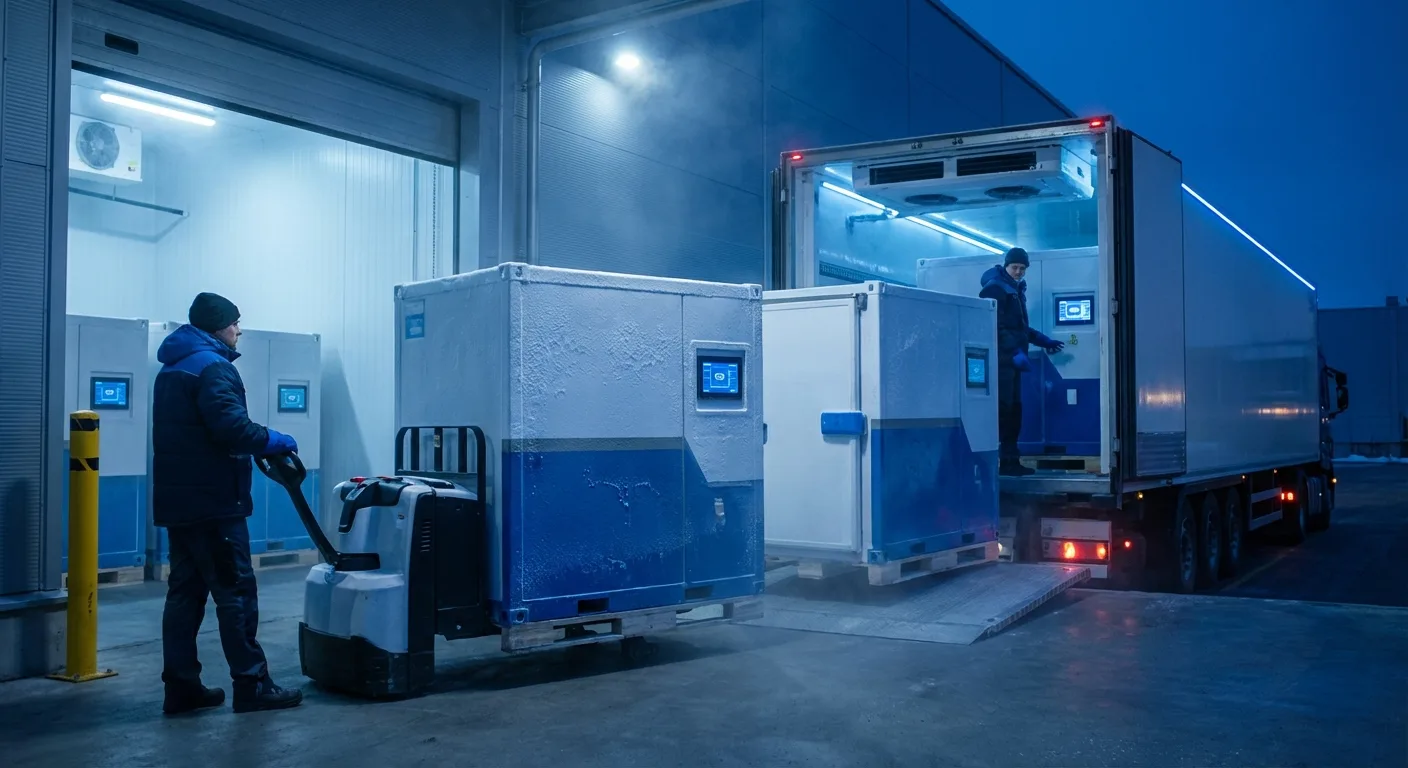
Frozen seafood transportation temperature should be maintained at -18°C or below, while cold-stored seafood should be maintained at 0°C to 7°C. Refrigerated vehicles should be pre-cooled to reach target temperature before loading begins. Door opening time during loading/unloading should be strictly controlled, and temperature recorders should be equipped for continuous monitoring throughout transport. The handover from cold storage to refrigerated vehicle loading is another high-risk point in the fishery cold chain, where dock seals or cooling corridors should be installed to minimize temperature breaks.
3. CCP Critical Control Point Setup and Monitoring Plans
Correct CCP setup is key to HACCP plan success in the fishery cold chain system. Not all temperature control points should be designated as CCPs — too many CCPs dilute monitoring resources and cause management fatigue, while too few may miss important hazard control nodes. According to the Codex decision tree logic, a CCP should be a control point where "control at that point is essential to prevent, eliminate, or reduce a food safety hazard to an acceptable level"[1].
Typical Fishery Cold Chain CCP Setup
The following are examples of common CCP setups in fishery cold chains. Actual setups should be individually adjusted based on each fishery association's operational process and hazard analysis results:
- CCP-1 Catch Receiving Temperature: Critical limit of fresh fish core temperature ≤ 4°C, frozen fish core temperature ≤ -18°C. Each incoming batch measured with probe thermometer on representative samples. Rejection or corrective action when exceeded
- CCP-2 Blast Freezing Endpoint Temperature: Critical limit of fish core temperature ≤ -18°C. Continuously monitored with core temperature probes, with sampling verification after freezing completion. Items not meeting standards undergo extended freezing time or equipment capacity reassessment
- CCP-3 Frozen Storage Temperature: Critical limit of storage temperature ≤ -18°C (general frozen) or ≤ -50°C (ultra-low temperature). Continuously monitored with automatic temperature recorders, with anomaly temperature alarm threshold set 2°C above the critical limit
- CCP-4 Storage-to-Vehicle Handover Temperature: Critical limit of product surface temperature rise not exceeding -15°C. Spot-checked with infrared thermometer during each outbound operation, with handover operation time shortened or cooling corridor activated when exceeded
Monitoring Frequency and Methods
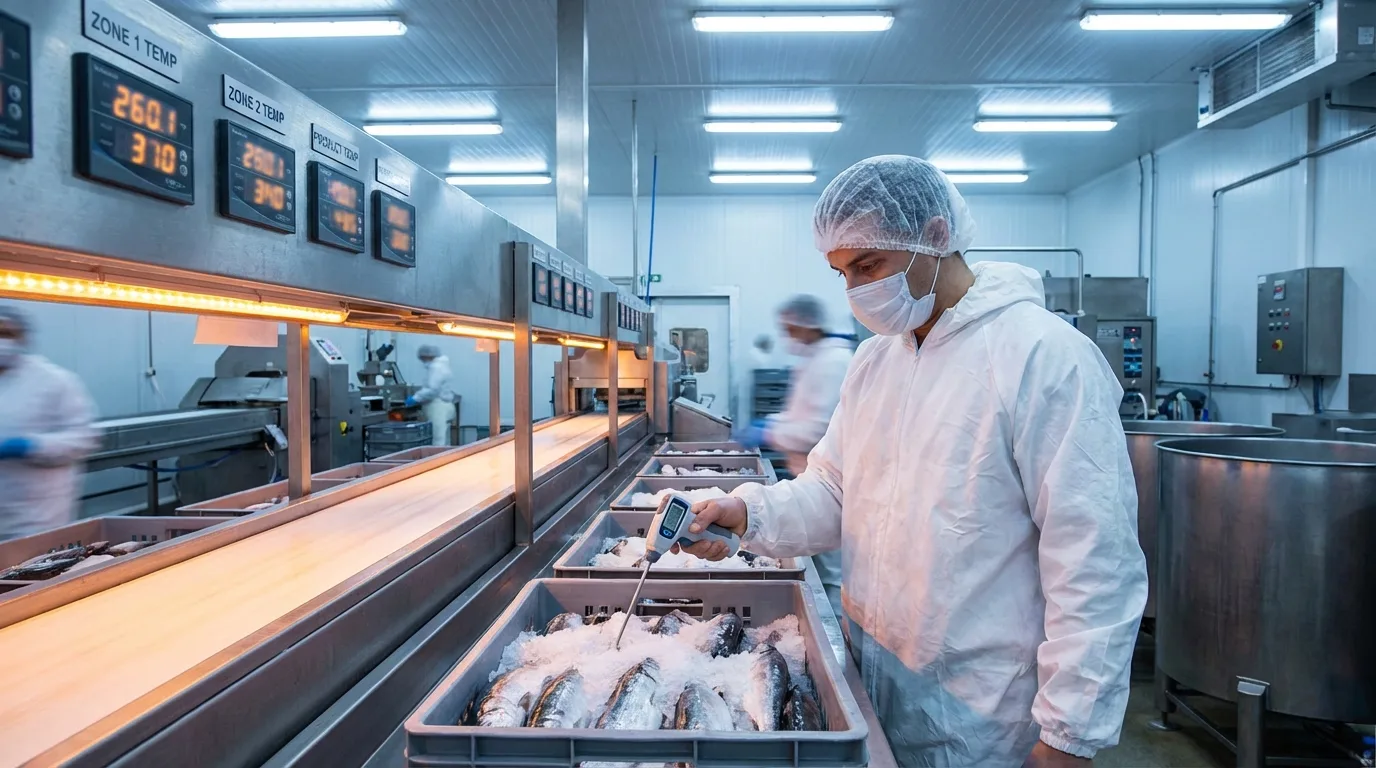
Monitoring frequency design must balance food safety assurance with operational feasibility. For continuous temperature hazards (such as frozen storage), automatic continuous recording is best practice — temperature recorder sampling intervals are typically set at every 5 to 15 minutes, with data automatically uploaded to cloud platforms. For batch-type temperature checks (such as receiving temperature, freezing endpoint temperature), manual measurement is performed per batch or per specified quantity. All monitoring data should include complete information such as date, time, measured value, measuring personnel, and determination result.
Need professional planning for fishery cold chain temperature control systems? Contact our engineering team for HACCP-compliant temperature monitoring solutions.
4. Temperature Recording Systems: Wired Sensors vs Wireless IoT vs Cloud Monitoring
Temperature recording systems are the technical implementation carriers for HACCP Principle 4 (Monitoring Systems) and Principle 7 (Documentation). A reliable temperature recording system must not only measure accurately and record faithfully but also issue real-time alerts when anomalies occur and provide complete historical data for traceability and auditing. With the evolution of sensing and communication technologies, fishery associations can choose from temperature recording solutions ranging from traditional wired systems to modern cloud IoT solutions, each with distinct technical characteristics and applicable scenarios[7].
Wired Sensing Systems
Wired sensing systems use thermocouples or RTDs (Resistance Temperature Detectors) as sensing elements, connected via signal cables to local data loggers or PLCs (Programmable Logic Controllers). Advantages include stable signal transmission unaffected by wireless interference, high long-term operational reliability, and sensor accuracy reaching within ±0.1°C after calibration. Disadvantages include: higher cabling installation costs, cable routing needing to penetrate cold storage walls (requiring proper waterproofing and insulation sealing), limited flexibility in adding or removing sensor points, and data typically stored only locally, making remote real-time monitoring difficult.
Wireless IoT Sensing Systems
Wireless IoT temperature sensors use LPWAN (Low Power Wide Area Network) technologies such as LoRa, NB-IoT, or Sigfox to wirelessly transmit temperature data to gateways, then upload to cloud platforms. The greatest advantage is ease of installation — no signal cable deployment needed, sensors are battery-powered, and can be flexibly deployed at various monitoring points including cold storage interiors, transport vehicle compartments, and unloading docks. LoRa technology offers good penetration capability, maintaining stable communication even in shielded environments like cold storage metal wall panels. Wireless sensor accuracy is typically within ±0.3°C to ±0.5°C, sufficient for HACCP critical limit monitoring. Key considerations include battery life (low temperatures accelerate battery depletion), wireless signal stability in ultra-low temperature environments, and sensor waterproof/moisture-proof ratings.
Cloud Monitoring Platforms
Regardless of whether wired or wireless sensors are used at the front end, modern temperature recording systems typically pair with cloud monitoring platforms providing the following core functions: real-time temperature dashboards displaying live temperatures at each monitoring point; anomaly temperature alerts notifying management personnel via multiple channels (SMS, LINE push notifications, email) when measured values approach or exceed critical limits; historical trend charts allowing temperature change trend queries by time period at each point with automatic anomaly segment marking; and automatic generation of HACCP-format temperature record reports for audit personnel review[8].
System Selection Recommendations
For small to medium fishery cold storage (capacity under 100 tons), wireless IoT sensors paired with cloud platforms currently offer the best cost-performance ratio, with minimal installation work, short deployment periods, and simple subsequent maintenance. Large fishery cold storage facilities (capacity of several hundred tons or more, including multiple cold storage rooms and processing areas) are recommended to use wired RTD sensors with PLC control systems as the core monitoring architecture, then upload data to cloud platforms via gateways, balancing precision, stability, and remote monitoring needs. Regardless of the solution chosen, periodic sensor calibration (recommended at least annually, using NIST-traceable standards) is a fundamental requirement for maintaining measurement data credibility.
5. Corrective Actions and Traceability Management Processes
HACCP Principle 5 clearly requires that when monitoring results show a CCP deviating from critical limits, pre-established corrective action procedures should be immediately initiated. Corrective actions serve three purposes: first, immediately controlling the deviation to prevent hazard expansion; second, handling affected products to ensure unsafe products do not enter the market; and third, investigating deviation causes and implementing systematic corrections to prevent recurrence[1].
Tiered Handling of Temperature Deviations
In fishery cold chain practice, temperature deviations can be classified into three tiers for handling based on severity:
- Minor Deviation: Temperature exceeds the critical limit but recovers within a preset allowable time. For example, cold storage temperature temporarily rises to -16°C due to defrost operations but returns to below -18°C within 30 minutes. Such deviations typically do not affect product safety but still require complete documentation and review of whether defrost timing settings are appropriate
- Significant Deviation: Temperature exceeds the critical limit for an extended duration, with product safety requiring evaluation before determination. For example, storage temperature rises to -12°C for over 2 hours due to compressor failure. Affected products should be isolated and marked, with quality safety personnel evaluating based on time-temperature cumulative effect to decide on release, downgrade use, or disposal
- Critical Deviation: Temperature is severely out of control with clearly compromised product safety. For example, storage temperature rises above 0°C for several hours due to power failure and backup power not activating. All affected products should be immediately marked as non-conforming, processed per disposal procedures, and a comprehensive cause investigation and improvement process initiated
Batch Number System for Traceability Management
Effective traceability management is built upon a comprehensive batch number system. Fishery association seafood batch coding should include at minimum the following information dimensions: fishing vessel or supplier source code, unloading date, species or product code, processing batch sequence number, and cold storage location number. When temperature deviation events occur, management personnel can quickly identify the scope of affected products through batch numbers, avoiding unnecessary economic losses from having to expand the disposition scope due to unclear traceability. ISO 22000:2018 further requires organizations to establish traceability systems capable of identifying incoming material sources and primary distribution routes for finished products[9].
Root Cause Analysis and Preventive Measures
Corrective actions should not stop at disposing of affected products but should investigate the root cause of deviation events. Common root causes of temperature deviations include: compressor aging leading to reduced refrigeration capacity, severe evaporator frost blocking heat exchange efficiency, damaged door seals causing cold air leakage, temperature sensor drift causing measurement value deviation, and improper personnel operations (such as door open times that are too long or excessive single-batch loading). For each significant deviation event, root cause analysis should be conducted using tools such as the "5 Why" method or fishbone diagrams, with specific preventive measures and implementation timelines established, and improvement effectiveness tracked by the HACCP team.
6. Audit Preparation and Common Deficiency Improvements
Effective HACCP system operation needs to be verified through regular internal and external audits. For fishery associations, external audits may include routine inspections and special investigations by health authorities (local health bureaus, Food and Drug Administration), ISO 22000 or HACCP certification audits by certification bodies, and supplier audits by clients (such as major retailers, export trading companies)[10]. Thorough audit preparation is key to demonstrating HACCP system maturity.
Systematic Management of Documents and Records
The primary task of audit preparation is ensuring the completeness, consistency, and accessibility of all HACCP-related documents and records. Core documents to be prepared include at minimum: the HACCP plan (including hazard analysis tables, CCP determination records, and HACCP control tables), prerequisite program documents (GHP standard operating procedures), temperature monitoring records (retained for at least five years), corrective action records, verification activity records (such as sensor calibration reports and product microbiological test reports), internal audit reports, and management review records. Documents should have clear version control mechanisms, and records should have tamper-prevention security measures — cloud temperature monitoring platforms have a natural advantage here, as data cannot be modified by on-site personnel once uploaded[11].
Common Audit Deficiencies and Improvement Measures
Based on practical experience, common deficiencies found in HACCP audits of fishery cold chain facilities can be summarized into the following categories:
- Incomplete or intermittent temperature records: Manual recording is prone to missed entries, backfilling, or even fabrication. Improvement measure: implement automatic temperature recording systems to eliminate the possibility of human error
- Sensors not regularly calibrated: Thermometer measurement accuracy drifts over time, and uncalibrated data lacks credibility. Improvement measure: establish an annual calibration plan, retain calibration records and certificates, and retrospectively evaluate historical data validity when calibration results show deviation
- Critical limits set without scientific basis: Some fishery association critical limits are merely "empirical values" without explanation of their relationship to food safety hazards. Improvement measure: establish scientifically grounded critical limits referencing Codex standards, Ministry of Health and Welfare regulations, and academic literature, retaining decision records
- Corrective actions are merely formalities: Records only state "handled" without specifying the specific disposition method, cause investigation process, or preventive measures. Improvement measure: design structured corrective action record forms requiring item-by-item completion of deviation description, product disposition method, root cause analysis results, and preventive measures
- Insufficient prerequisite program (PRP) implementation: Facility maintenance deficiencies such as poor cold storage door sealing, blocked drainage pipes, and inadequate lighting reflect insufficient PRP execution. Improvement measure: establish preventive maintenance plans for facilities and equipment, conduct regular inspections, and retain maintenance records
Mock Audits and Continuous Improvement
Fishery associations are recommended to conduct internal mock audits at least one month before formal audits, with personnel trained in audit techniques serving as mock auditors, reviewing each item on the audit checklist. Deficiencies found during mock audits should be corrected before the formal audit. More importantly, the HACCP system should be viewed as a continuous improvement cycle — findings from each audit (whether internal or external), root cause analysis results from each temperature deviation event, and conclusions from each quarterly management review should all feed back into HACCP plan updates and optimization, forming a positive Plan-Do-Check-Act (PDCA) cycle[12].
Conclusion
Fishery HACCP temperature compliance is not a one-time project but a management system requiring continuous investment and optimization. From correct understanding and implementation of the seven HACCP principles to strict adherence to temperature standards at each stage of seafood handling; from scientific CCP critical control point setup to technical selection and deployment of temperature recording systems; from timely and effective execution of corrective actions to complete linkage of traceability management; from systematic preparation for audits to fundamental improvement of common deficiencies — every aspect requires close integration of food safety management systems and HVAC engineering technology. Only when the institutional HACCP plan is supported by precise and reliable temperature control engineering, and when engineering temperature monitoring data is incorporated into structured management processes, can fishery cold chain temperature management truly advance from "meeting minimum regulatory requirements" to "systematic capability for ensuring food safety." This is not only a responsibility to consumer health but also an essential path for Taiwan's fishery cold chain to reach international standards.