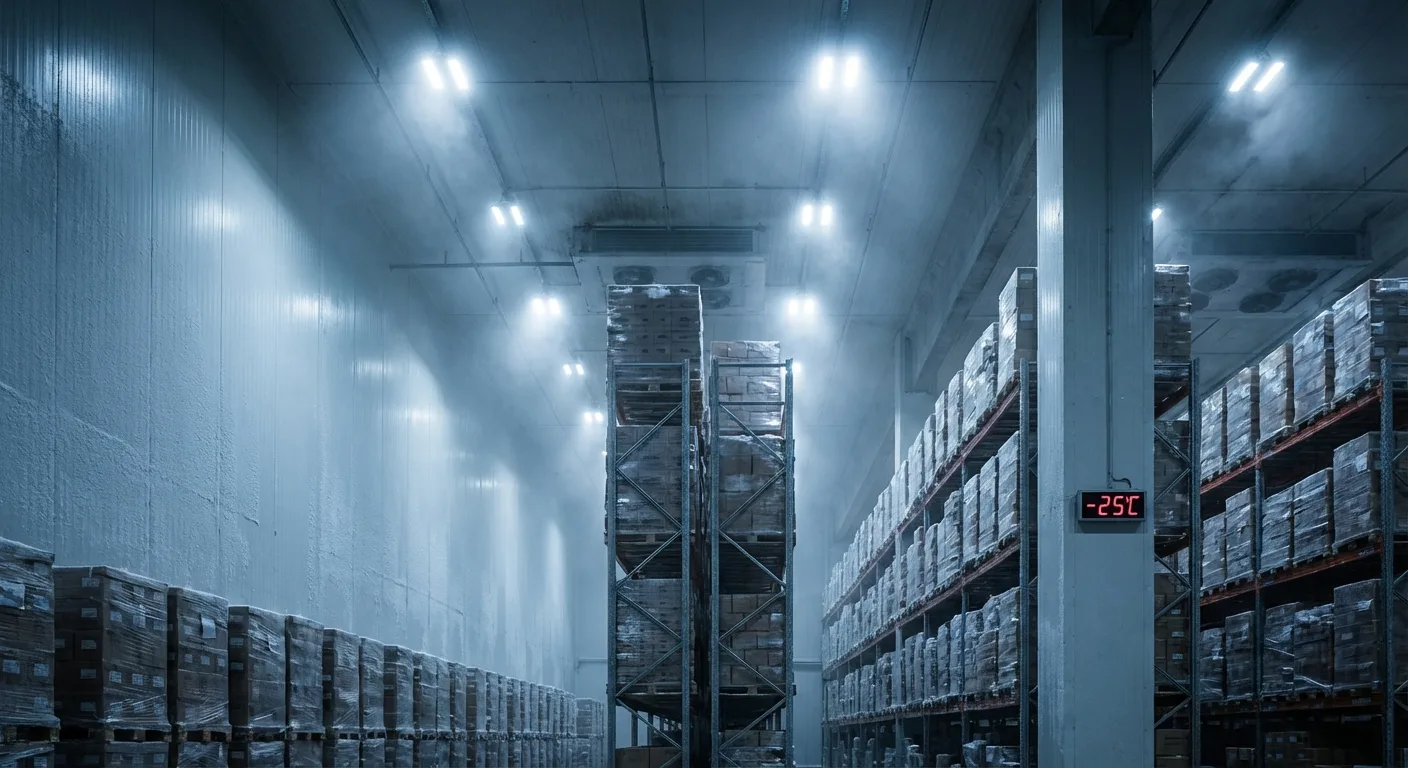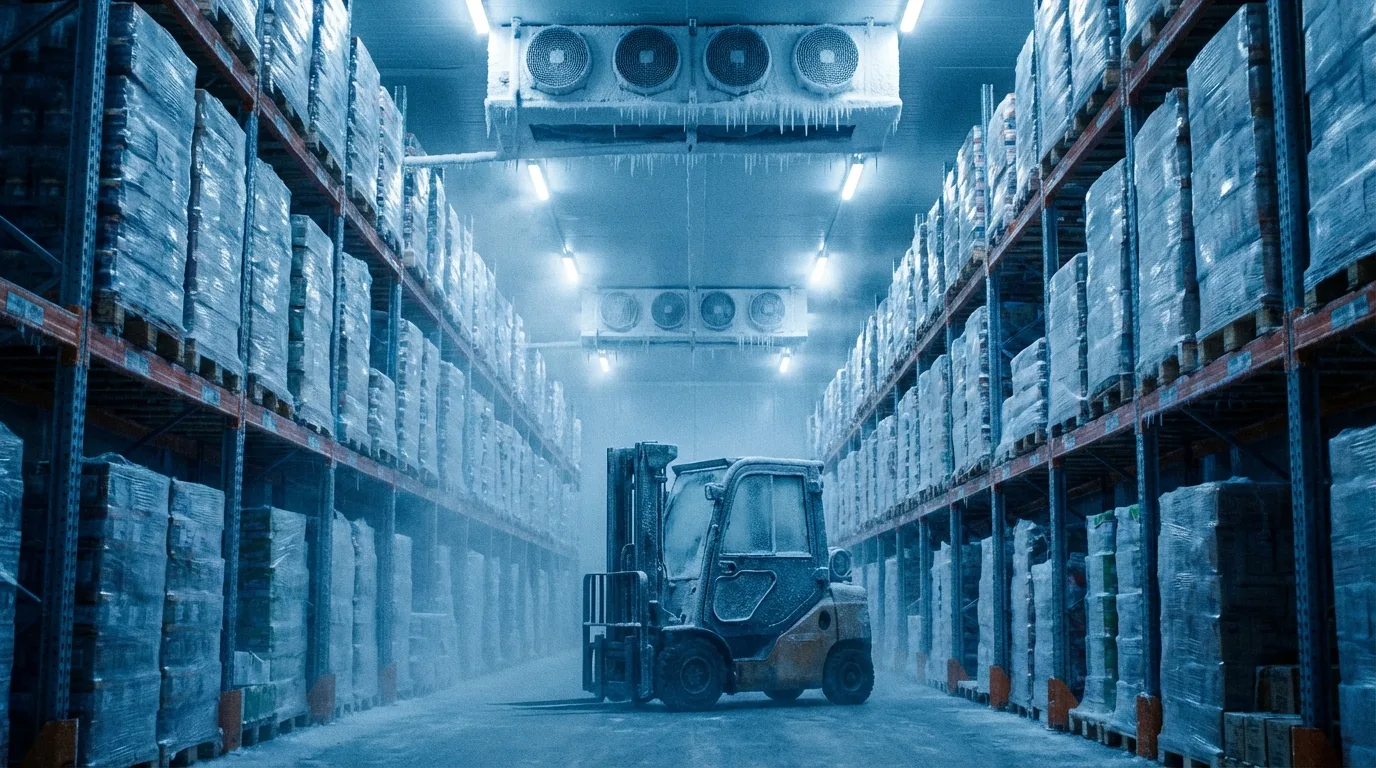
Cold and frozen storage facilities are indispensable infrastructure for food processing, logistics warehousing, pharmaceutical preservation, and agriculture and fisheries industries. From the small cold room behind a convenience store to an automated low-temperature logistics center spanning thousands of square meters, different scales and applications of cold/frozen storage have significant differences in temperature specifications, capacity planning, load calculations, and equipment configurations. A well-designed frozen storage facility not only ensures product quality and food safety compliance but also saves considerable energy costs over decades of operation. This article, from the practical perspective of a refrigeration and air conditioning engineer, progressively covers classification and temperature standards, capacity calculation, load analysis, equipment selection, envelope structure, and energy efficiency strategies, providing a systematic technical reference for cold chain engineering planning and decision-making.
1. Classification and Temperature Standards for Cold and Frozen Storage
Cold and frozen storage can be categorized into multiple types based on purpose and storage temperature. Internationally, the ASHRAE Handbook -- Refrigeration and the International Institute of Refrigeration (IIR) classifications serve as universal benchmarks[1], while Taiwan also has mandatory requirements under the Good Hygiene Practice for Foods and related regulations for food storage temperatures[2]:
- High-Temperature Cold Storage (+2 degrees C to +10 degrees C): Short-term preservation of fruits, vegetables, dairy products, and fresh meat. Taiwan regulations require refrigerated food center temperature to be maintained below 7 degrees C
- Low-Temperature Cold Storage (0 degrees C to +2 degrees C): High-value fresh products sensitive to temperature such as fresh fish and premium meats, requiring precision temperature control (plus/minus 0.5 degrees C)
- Frozen Storage (-18 degrees C to -25 degrees C): Long-term storage of frozen foods, meeting HACCP and Codex Alimentarius basic requirements. Taiwan regulations stipulate frozen food center temperature must be maintained at -18 degrees C or below
- Low-Temperature Frozen Storage (-25 degrees C to -35 degrees C): Applications requiring longer shelf life, such as seafood processed products and prepared foods
- Ultra-Low Temperature Storage (-40 degrees C to -60 degrees C): Deep-sea tuna sashimi-grade preservation, pharmaceutical and biotech samples, vaccines, and other special needs, typically requiring cascade refrigeration systems
Temperature classification directly determines the complexity and energy consumption levels of the refrigeration system architecture. For a -25 degrees C frozen storage in Taiwan with summer outdoor temperatures of 35 degrees C, the indoor-outdoor temperature differential reaches 60 degrees C, causing compression ratio and compressor power consumption to increase dramatically. Correct temperature specification is the starting point for all subsequent design -- an unnecessarily low setpoint not only increases equipment investment and operating costs but also provides no additional benefit to product quality[3].
2. Cold/Frozen Storage Capacity Calculation Methods
Correct capacity calculation is critical for space efficiency and investment reasonability. Capacity calculation must comprehensively consider three core parameters: storage capacity, turnover rate, and space utilization factor[4].
Storage Capacity
Storage capacity refers to the product weight (metric tons) that can be accommodated at full load. Stacking densities vary significantly among products: frozen meat approximately 400--500 kg/m3, frozen seafood approximately 350--450 kg/m3, and frozen fruits and vegetables approximately 250--400 kg/m3 depending on packaging method. Design should calculate required effective storage volume item by item based on the client's product mix and packaging specifications.
Turnover Rate
Turnover rate reflects the average dwell time and frequency of product movement in and out of storage. Distribution warehouses typically have much higher turnover rates than processing storage -- the former may turn over 2--3 times per week, while the latter may take months to complete a full cycle. High turnover rates mean larger daily incoming product volumes, directly affecting product pull-down load calculations.
Space Utilization Factor
Actual usable storage space is typically only 50%--70% of total facility volume. Deductions include: aisle space (main aisle width must accommodate forklifts or automated storage systems), pallet stacking clearances (ensuring cold air circulation), clearance between ceiling and evaporators, and dead zones occupied by columns and fire protection equipment. For pallet-stacked frozen storage, effective storage volume is approximately 55%--65% of total volume; with Automated Storage and Retrieval Systems (AS/RS), space utilization can increase to 70%--80%.
Need a quick estimate for your cold or frozen storage capacity? Use our Cold Storage Capacity Calculator -- enter product type, storage volume, and turnover rate to get preliminary recommendations.
3. Refrigeration Load Calculation: Six Major Heat Sources
Precise refrigeration load calculation is the fundamental basis for compressor selection and system design. According to ASHRAE Handbook -- Refrigeration Chapter 24 methodology[5], the total refrigeration load of a frozen storage consists of six major heat sources:
1. Transmission Load
Heat transmitted through the six surfaces of the storage envelope (four walls, ceiling, floor) from outside to inside. The formula is Q = U x A x Delta-T, where U is the overall heat transfer coefficient (W/m2 K), A is the heat transfer area (m2), and Delta-T is the indoor-outdoor temperature differential (K). Transmission load typically accounts for 15%--30% of total load and depends on insulation material thickness and performance, as well as the presence of thermal bridges. Special attention is needed for partition walls between adjacent different temperature zones, such as the wall between a cold storage zone (+4 degrees C) and a frozen zone (-25 degrees C), which still has a 29 degrees C temperature differential.
2. Infiltration Load
Sensible and latent heat brought in by warm, humid outdoor air rushing into storage during door opening operations. This is the load item most easily underestimated in practice. According to the classic research by Gosney and Olama[6], air infiltration volume during frozen storage door opening is positively correlated with door area, indoor-outdoor temperature differential, door opening duration, and opening frequency. For a high-throughput distribution frozen storage, infiltration load can account for 15%--35% of total load. Effective control measures include: high-speed doors (opening/closing time less than 3 seconds), air curtains, strip curtains, and anteroom installation.
3. Product Load
Heat that must be removed to cool incoming products from their initial temperature to target storage temperature. Calculation must be segmented by product state: sensible heat above freezing point (Q = m x Cp1 x Delta-T1), latent heat of fusion (Q = m x Lf), and sensible heat below freezing point (Q = m x Cp2 x Delta-T2). Additionally, fruits and vegetables continue to generate respiration heat even in low-temperature environments, which must be accounted for separately[7]. Product load can account for 30%--50% of total load in high-turnover frozen storage, making it the single largest load source.
4. Personnel Load
Body heat dissipated by workers inside storage. Each person generates approximately 210--270 W (depending on activity level). Although individual values are not large, this must be included in calculations for sorting areas or processing zones with intensive personnel activity.
5. Equipment Load
Heat generated by lighting, evaporator fan motors, forklifts, and other equipment operating inside storage. Evaporator fan motor heat dissipation requires particular attention -- large frozen storage evaporator fan total power can reach tens of kilowatts, all converted to internal heat load. Electric forklift charging heat dissipation inside storage should also not be overlooked.
6. Defrost Load
Heat injected into storage during the evaporator defrost process. Each electric defrost cycle causes storage temperature to rise 2--5 degrees C, and higher defrost frequency means greater cumulative defrost load. Large frozen storage defrost load can account for 5%--10% of total load[8]. Hot gas defrost can shorten defrost time and reduce storage temperature impact, but increases system piping and control complexity.
In engineering practice, after calculating all six loads, a safety factor of 10%--15% is typically added to cover calculation errors and future expansion allowance. The final design refrigeration capacity serves as the basis for equipment selection.
4. Refrigeration Compressor and Evaporator Selection
Compressor Selection
The compressor is the heart of the refrigeration system, and its selection depends on evaporating temperature, condensing temperature, and required refrigeration capacity. Different temperature ranges for frozen storage call for different compressor types[9]:
- Reciprocating Compressors: Suitable for small to medium cold storage (refrigeration capacity less than 50 kW), simple structure and lower cost, but volumetric efficiency degrades noticeably at low evaporating temperatures
- Screw Compressors: The mainstream choice for medium to large frozen storage (50--500 kW), featuring continuous compression, low vibration, and high reliability, with stepless capacity modulation from 10%--100% via slide valve
- Two-Stage Compression Systems: When evaporating temperature is below -30 degrees C (compression ratio greater than 8), single-stage compression produces excessively high discharge temperatures and sharply declining volumetric efficiency, requiring two-stage compression with an intercooler to improve system efficiency
- Cascade Systems: The standard approach for ultra-low temperature applications (-40 degrees C to -60 degrees C). High-temperature stage uses R-507A or HFO refrigerant, low-temperature stage uses CO2 or R-23, connected through a cascade heat exchanger
In recent years, driven by environmental regulations, the NH3 (R-717) primary refrigerant / CO2 (R-744) secondary refrigerant compound system has seen rapid growth in large frozen logistics center applications. This architecture combines the high energy efficiency of NH3 with the low toxicity advantages of CO2, while confining NH3 usage within the machinery room, significantly reducing safety risks[10].
Evaporator Selection
Ceiling-mounted unit coolers are the mainstream evaporator type for frozen storage. Key parameters to consider during selection include:
- Refrigeration Capacity and Temperature Difference (TD): TD is defined as the difference between storage air temperature and evaporating temperature. Cold storage TD is typically 6--8 K, while frozen storage TD is 5--7 K. Smaller TD means higher evaporating temperature and better compressor efficiency, but requires larger evaporator area and higher initial cost
- Fin Spacing: Cold storage (above 0 degrees C) can use 4--6 mm close-fin spacing to increase heat transfer area; frozen storage (below -18 degrees C) should use 8--12 mm wide-fin spacing to slow frost formation and extend defrost intervals
- Throw Distance and Airflow Distribution: Evaporator throw distance must cover the effective length of the storage room, ensuring uniform temperature distribution (temperature variation controlled within plus/minus 1 degree C)
- Defrost Method: Electric defrost is lower cost but has greater impact on storage temperature during defrost; hot gas defrost is faster with less storage temperature impact, suitable for large frozen storage; water defrost is suitable for cold storage
5. Envelope Structure and Insulation Design
Envelope insulation performance directly determines transmission load magnitude and is a key factor in long-term operating energy consumption. Modern cold/frozen storage envelope structures are primarily of two types: prefabricated panel systems and field-applied foam systems[11].
Polyurethane (PUR/PIR) Sandwich Panels
Prefabricated cold storage panels are the current market mainstream, with double-sided color-coated steel sheets sandwiching PUR or PIR (polyisocyanurate) rigid foam core. PIR panels have a thermal conductivity of approximately 0.022--0.025 W/(m K) and better fire resistance (self-extinguishing). Panel thickness selection must balance insulation performance and economics:
- Cold Storage (0 degrees C to +10 degrees C): Wall panels 75--100 mm, ceiling 100 mm
- Frozen Storage (-18 degrees C to -25 degrees C): Wall panels 150--200 mm, ceiling 200 mm
- Ultra-Low Temperature Storage (-35 degrees C to -60 degrees C): Wall panels 200--250 mm, ceiling 250 mm
Panel joint treatment is the weak point of insulation design. Tongue-and-groove (cam-lock) connections combined with polyurethane sealant injection can effectively reduce thermal bridge effects at joints. All wall penetrations for piping, electrical conduit, and door frames should be fully wrapped with insulation material to prevent thermal bridges.
Vapour Barrier
A significant water vapor partial pressure differential exists between the interior and exterior of frozen storage envelopes. If the vapour barrier is improperly designed, water vapor will migrate from the high-pressure side (exterior) through insulation material toward the low-pressure side (interior), condensing within the material (interstitial condensation) and degrading insulation performance. The vapour barrier should be installed on the warm side (exterior) of the insulation material, using common materials including aluminum foil composite film, polyethylene film, or bituminous coatings with vapour resistance meeting design requirements.
Frost Heave Prevention
When frozen storage floor temperature drops below 0 degrees C, moisture in the subgrade soil freezes and expands, producing frost heave forces that cause floor upheaval, cracking, and even structural damage. This is the most consequential yet most easily overlooked risk in frozen storage design[5]. Engineering measures for frost heave prevention include:
- Floor Heating System: Electric heating cables or hot water piping embedded below the insulation layer (warm side) to maintain subgrade temperature above 0 degrees C. Electric heating cable power density is typically 15--30 W/m2, requiring temperature sensors and automatic control
- Ventilated Floor: Raised floor creates a ventilation cavity below the insulation layer, using natural or mechanical ventilation to remove cold. This approach has higher initial cost but lower operating cost, suitable for large frozen storage
- Gravel Ventilation Layer: Gravel layer placed below the insulation layer with ventilation piping, providing both structural support and frost prevention
6. Cold/Frozen Storage Energy Efficiency Strategies and Smart Monitoring
Frozen storage is a characteristically high-energy facility, with compressors accounting for 60%--70% of electricity consumption, evaporator fans 15%--20%, and condensers and other equipment accounting for the remainder[12]. With industrial electricity prices in Taiwan continuing to rise, the investment payback period for energy-efficient design is significantly shortening. Key energy efficiency strategies include:
Equipment-Level Energy Savings
- Variable Frequency Compressors: Adjusting compressor speed based on actual refrigeration load avoids frequent start/stop cycles and unloading losses of traditional fixed-frequency machines. At part-load operation, VFD control can save 15%--30% of compressor electricity
- Evaporative Condensers: Compared to air-cooled condensers, evaporative condensers use water's latent heat of vaporization for cooling, reducing condensing temperature by 8--12 degrees C. Each 1 degree C reduction in condensing temperature improves compressor COP by approximately 2%--3%
- EC Fan Motors: Electronically commutated (EC) motors for evaporator and condenser fans save 30%--50% compared to traditional induction motors, and reduced fan heat also indirectly lowers internal heat load
- VFD Water Pumps and Cooling Towers: VFD-driven pumps and fans in cooling water systems automatically adjust based on condensing pressure or outdoor wet-bulb temperature
System-Level Energy Savings
- Floating Suction Pressure Control: Dynamically raising the evaporating pressure setpoint based on actual storage temperature (rather than fixing at the lowest design point) can significantly improve system COP during light-load periods
- Floating Head Pressure Control: During autumn/winter or nighttime, lowering the condensing pressure setpoint based on outdoor air temperature fully leverages low-temperature ambient conditions
- Demand Defrost: Using evaporator entering/leaving air temperature differential or coil surface temperature as defrost triggers, replacing fixed-time schedules, reducing unnecessary defrost cycles by 30%--50%
- Heat Recovery: Utilizing compressor discharge high-temperature waste heat to preheat domestic hot water or office heating. With frozen storage operating year-round, heat recovery economics are very significant
Management-Level Energy Savings
- Off-Peak Thermal Storage: Increasing refrigeration system operation during lower-cost off-peak hours (Taipower time-of-use rates 22:30--07:30) to lower storage temperature to the lower setpoint limit, then reducing load during peak hours to cut demand charges and electricity costs
- Optimized Loading/Unloading Schedules: Concentrating loading/unloading into specific time windows, reducing door opening frequency, combined with anteroom buffer design, effectively reduces infiltration load
- LED Lighting Conversion: Converting traditional metal halide fixtures to LED reduces lighting electricity by over 60%, and the reduced heat output also significantly decreases internal heat load
Smart Monitoring and Preventive Maintenance
Modern frozen storage SCADA/BMS monitoring systems can integrate real-time data including temperature, humidity, pressure, current, and power. Combined with IoT sensors and cloud platforms, they enable the following advanced functions:
- Multi-zone temperature trend analysis and anomaly alerts (meeting HACCP continuous monitoring requirements)
- Compressor operating efficiency tracking (real-time COP calculation and historical comparison)
- Evaporator frost detection and smart defrost triggering
- Equipment vibration and current waveform analysis for predictive maintenance
- Energy dashboard and baseline comparison to quantify energy-saving results
Planning a cold or frozen storage construction project? Use our Cold Storage Capacity and Load Calculator to quickly obtain preliminary design parameters as a starting point for engineering planning.
Conclusion
Cold and frozen storage design is a systems engineering discipline integrating thermodynamics, fluid mechanics, materials science, automatic control, and food safety regulations. From establishing temperature specifications, precise capacity and load calculations, to rational compressor and evaporator selection, rigorous envelope insulation and frost heave prevention design, and comprehensive energy efficiency strategies with smart monitoring implementation -- every element is interconnected and interdependent. With Taiwan's cold chain industry rapidly upgrading, energy costs continuing to rise, and HACCP food safety regulations becoming increasingly stringent, the design threshold for frozen storage engineering will only grow higher. Only through systematic engineering thinking, solid calculation foundations, and extensive practical experience can cold/frozen storage facilities be designed to balance performance, safety, and economics.