In the global wave toward net-zero carbon emissions, energy transition in the building sector is an unavoidable engineering challenge. Among these, domestic hot water supply has long relied on electric resistance water heaters or gas boilers, accounting for 15% to 30% of total building energy consumption — second only to air conditioning. Heat Pump Water Heating Systems, with their outstanding energy efficiency — each kilowatt-hour of electricity consumed can "transfer" 3 to 5 kilowatt-hours equivalent of environmental thermal energy — have been identified by the IEA (International Energy Agency) as a key technology pathway for building decarbonization[1]. This article systematically analyzes the thermodynamic principles, equipment classification and selection, commercial system design essentials, Taiwan climate suitability, energy-saving benefit calculations, common design errors, and maintenance recommendations for heat pump water heating systems from the professional perspective of a refrigeration and air conditioning engineering consultant, providing comprehensive design guidelines for hotels, hospitals, dormitories, factories, and other large-scale hot water demand facilities.
1. Thermodynamic Principles of Heat Pumps: How the Reverse Carnot Cycle "Transfers" Heat
The operating principle of a heat pump is identical to that of an air conditioner — both are based on the vapor compression refrigeration cycle following the Reverse Carnot Cycle. The only difference lies in where the "useful energy" is extracted: an air conditioner utilizes the cooling effect at the evaporator, while a heat pump utilizes the heat rejection at the condenser. In a heat pump water heating system, the refrigerant absorbs low-temperature thermal energy from the environment (air, water, or ground) at the evaporator, is compressed by the compressor to increase both temperature and pressure, then releases high-temperature thermal energy to water at the condenser, completing the process of "transferring heat from a low-temperature environment to high-temperature hot water"[2].
Physical Meaning of COP
The core metric for measuring heat pump efficiency is the heating Coefficient of Performance COPh, defined as "the heat released at the condenser Qh divided by the work consumed by the compressor W." For a typical air-source heat pump operating at 20°C ambient temperature with 55°C outlet water temperature, COPh typically ranges from 3.5 to 4.5 — meaning for every 1 kWh of electrical energy input, 3.5 to 4.5 kWh of hot water thermal energy is produced. Of this, approximately 1 kWh comes from the conversion of compressor work, while the remaining 2.5 to 3.5 kWh is renewable energy "freely transferred" from the ambient air[3].
Theoretically, the maximum COPh of the Reverse Carnot Cycle = Th / (Th - Tc), where Th is the condensing temperature (absolute) and Tc is the evaporating temperature. This means: the higher the evaporating temperature (higher ambient temperature) and the lower the condensing temperature (lower outlet water temperature), the higher the COP. This fundamental relationship directly guides heat pump system design strategy — utilize the highest possible temperature heat source and reasonably control outlet water temperature.
Efficiency Comparison with Other Heating Methods
For an objective comparison of different water heating technologies' energy efficiency, the following uses "Primary Energy Efficiency" as a unified basis:
- Electric Resistance Water Heater: Electrical-to-thermal conversion efficiency approaches 100% (COP = 0.95~0.98), but considering the average thermal efficiency at the power generation end of approximately 35%~40%, primary energy efficiency is only about 35%~40%
- Gas Boiler (Natural Gas/LPG): Conventional boiler thermal efficiency is approximately 80%~88%, condensing boilers can reach 95%~98%. Primary energy efficiency equals the boiler efficiency itself
- Solar Water Heater: Collection efficiency is approximately 40%~60%, but limited by weather and requires auxiliary heating; annual effective collection efficiency varies by region and system design
- Heat Pump Water Heater: COP 3.5~4.5, even accounting for generation-end efficiency, primary energy efficiency still reaches 120%~160%, far exceeding other heating methods[1]
From a carbon emissions perspective, using Taiwan's 2025 grid emission factor of approximately 0.495 kg-CO2/kWh, a heat pump produces approximately 0.11~0.14 kg-CO2 per kWh of thermal energy output, far lower than natural gas boilers at 0.20 kg-CO2/kWh and LPG boilers at 0.23 kg-CO2/kWh. As Taiwan's renewable energy share increases annually, the carbon emission advantage of heat pumps will become even more significant.
2. Heat Pump System Classification and Applicable Scenarios
Heat pump systems are classified into three main categories based on their low-temperature heat source: air-source, water-source, and ground-source. Each type has distinct characteristics in equipment cost, installation requirements, annual energy efficiency, and maintenance needs, requiring comprehensive evaluation based on project geographic conditions, water demand scale, and budget.
Air-Source Heat Pump (ASHP)
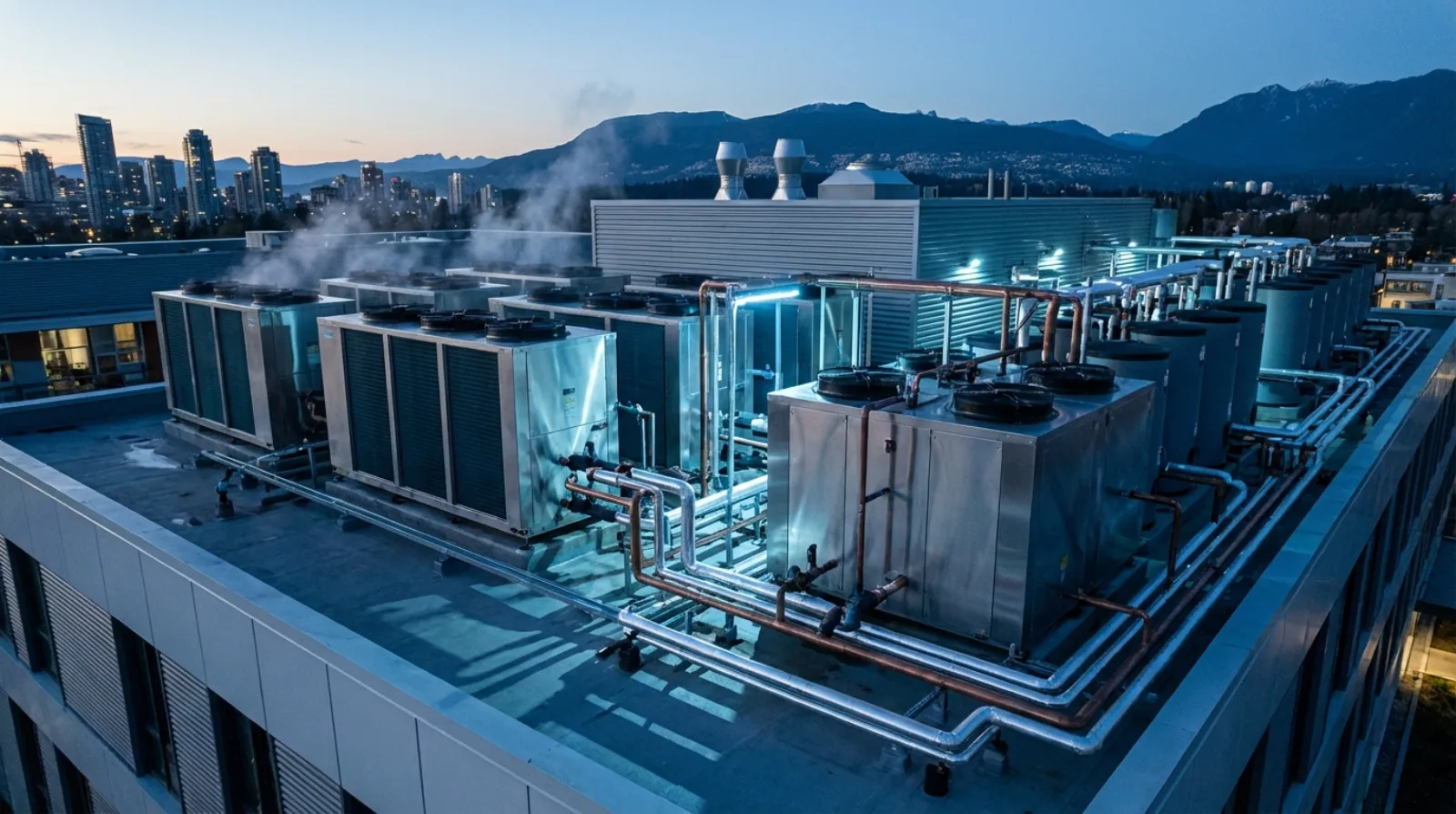
Air-source heat pumps use ambient air as the low-temperature heat source and currently hold the highest market share with the most mature technology. The outdoor unit's evaporator (finned heat exchanger) absorbs heat from the air, operating exactly like a residential air conditioner's outdoor unit — just "in reverse." The primary advantage of ASHP is installation simplicity — requiring only a well-ventilated outdoor location for the outdoor unit, without underground drilling or water source permits, offering the widest applicability. In southern Taiwan (Kaohsiung, Pingtung, Tainan), where annual average temperatures exceed 24°C, ASHP annual average COP can stably maintain between 3.8 and 4.5, making it an option with excellent cost-performance ratio[3].
The main limitation of ASHP is performance degradation in low-temperature environments. When ambient temperature drops below 7°C, the evaporator surface may frost, requiring the system to enter a Defrost Cycle, temporarily interrupting heating and consuming additional energy to melt the frost layer, causing COP to drop to 2.0~2.5. However, this issue has extremely limited impact in Taiwan's lowland areas (especially the south) — Kaohsiung's coldest winter monthly average temperature is approximately 18°C, with minimal defrost cycle frequency.
Water-Source Heat Pump (WSHP)
Water-source heat pumps use groundwater, river water, lake water, or industrial cooling water as the low-temperature heat source. Water's specific heat capacity is far greater than air (approximately 4,000 times per unit volume), and temperature fluctuations are much smaller than ambient air, resulting in high evaporator heat exchange efficiency and stable year-round operation for WSHP, with COP typically reaching 4.5 to 5.5[4]. Particularly suitable for locations near stable water sources, such as coastal hotels (seawater intake), industrial parks (utilizing process cooling water waste heat), or hot spring areas (utilizing hot spring tail water residual heat).
The limitation of WSHP lies in the regulatory and engineering conditions for water source acquisition. Groundwater extraction requires water rights permits from water resource authorities and must consider environmental risks of groundwater level decline and land subsidence. Seawater intake requires safeguards against biofouling and corrosion. Additionally, the water-side piping system (intake, filtration, discharge, or reinjection) increases installation costs and maintenance complexity.
Ground-Source Heat Pump (GSHP)
Ground-source heat pumps use the earth as a heat source or heat sink, exchanging heat with the ground through closed-loop pipes (Ground Loops) buried underground with circulating heat transfer fluid (typically water or antifreeze solution). In Taiwan, ground temperatures below 10 meters remain stable year-round at 22°C to 25°C, unaffected by surface climate fluctuations, resulting in the most stable year-round COP for GSHP at 4.5 to 5.8[5]. GSHP eliminates outdoor unit fan noise and large heat rejection space requirements, has long equipment life (underground piping can exceed 50 years), and is the most economical option from a Life Cycle Cost (LCC) perspective.
However, GSHP has the highest initial investment cost, primarily from underground loop pipe drilling and installation. Vertical loops typically have well depths of 80 to 150 meters, requiring approximately 60 to 90 meters of well depth per RT (refrigeration ton), with drilling costs in Taiwan of approximately NT$1,500 to 2,500 per meter. Additionally, underground loop pipe heat exchange capacity is significantly influenced by geological conditions, requiring Thermal Response Tests (TRT) before design to obtain precise design parameters. In Taiwan, GSHP applications remain uncommon, mainly found in government green building demonstration projects or high-end resorts.
Differences Between Commercial and Industrial Scale
In terms of system scale, commercial heat pumps (hotels, hospitals, dormitories, etc.) typically have single-unit heating capacity between 10 kW and 200 kW, using multiple units in parallel to meet peak demand; industrial-grade heat pumps (food processing plants, electroplating facilities, textile dyeing mills, etc.) may require single units exceeding 500 kW, with outlet water temperature requirements potentially reaching 80°C to 90°C, requiring specialized technologies such as two-stage compression or CO2 (R-744) transcritical cycles[2]. Industrial applications typically combine process waste heat recovery, with system design complexity and customization far exceeding commercial systems.
3. Commercial Heat Pump System Design Essentials
The design quality of commercial heat pump water heating systems directly determines system operating efficiency, hot water supply stability, and service life. The following addresses key design considerations from three perspectives: hot water demand estimation, storage tank design, and condenser heat recovery.
Hot Water Demand Estimation: Design Basis for Different Building Types
Accurate hot water demand estimation is the foundation for system capacity planning. ASHRAE Handbook — HVAC Applications, Chapter 50 provides hot water demand design data for various building types. Combined with local usage patterns in Taiwan, common building type design demands are as follows[2]:
- Tourist Hotels: 150~250 liters per room per day (60°C hot water); five-star hotels use the higher value, with bathtub rooms requiring an additional 150~200 liters per tub. Restaurant kitchens are calculated separately at approximately 15~25 liters per seat
- Student Dormitories: 40~60 liters per bed per day (60°C), with usage highly concentrated during evening hours 18:00~22:00 and peak coefficients reaching 3.0~4.0
- Hospitals: 100~150 liters per patient bed per day (60°C), including nursing station washing and central supply room instrument cleaning water. Legionnaires' disease (Legionella) prevention regulations require storage water temperature not below 60°C[6]
- Factory Employee Dormitories/Shower Rooms: 30~50 liters per person per shift (45°C), with concentrated usage at shift end
- Swimming Pools/SPAs: Pool water heating requirements are calculated based on pool volume and target water temperature, with daily heat loss replenishment of approximately 5%~10% of total pool water thermal energy
Design hot water demand should be based on Maximum Day Demand, multiplied by a safety factor of 1.1 to 1.2. Additionally, special attention must be paid to Peak Hour Demand — this determines the ratio between hot water storage tank capacity and heat pump instantaneous heating capacity.
Storage Tank Capacity Calculation and Insulation Design
The Hot Water Storage Tank plays an "energy buffer" role in heat pump systems, with capacity design needing to balance two factors: oversized tanks increase initial investment and footprint while increasing standby heat losses; undersized tanks may result in insufficient supply during peak periods or require oversized heat pump capacity for immediate heating. ASHRAE design recommendations state: effective storage tank capacity should cover at least 70% to 100% of peak hour demand[2].
For example, a 200-room hotel: maximum daily hot water demand is approximately 200 x 200 = 40,000 liters (60°C), with peak hour (morning 06:00~08:00) demand at approximately 25% of daily total, or 10,000 liters/hour. If the storage tank is designed to cover 80% of peak hourly demand, the tank capacity would be 8,000 liters (8 tons), with the remaining 20% supplemented by heat pump real-time heating. The heat pump design heating capacity is then calculated based on "restoring the tank to full temperature during off-peak hours" — if recovery time is 8 hours, required heating power is approximately 40,000 x 4.186 x (60-15) / (8 x 3,600) = 262 kW.
Storage tank insulation design directly affects standby heat losses. Per ASHRAE Standard 90.1 requirements, storage tank surface heat loss rate must not exceed 6.8 W/m2 (calculated at 60°C storage temperature, 20°C ambient temperature)[7]. Engineering practice recommends polyurethane foam (PUR) insulation thickness of 75 mm to 100 mm, with aluminum or stainless steel jacket covering. Tank material should preferably be SUS 304 or SUS 316 stainless steel; enamel-coated carbon steel tanks are lower cost but prone to enamel cracking and corrosion issues with long-term use in areas with hard water, such as Kaohsiung.
Condenser Heat Recovery: HVAC Waste Heat Reuse
In buildings with simultaneous air conditioning cooling and hot water supply demands (such as hotels and hospitals), the condenser waste heat from HVAC systems is an extremely valuable "free" heat source. Traditional central air conditioning systems reject condenser heat to the atmosphere through cooling towers, wasting large amounts of low-grade thermal energy. Condenser Heat Recovery technology routes the high-temperature refrigerant vapor (approximately 65°C~85°C) from the compressor discharge through a heat recovery heat exchanger to preheat domestic water before sending it to the cooling tower for remaining heat rejection.
The engineering benefits of condenser heat recovery are substantial: for a 500 RT central air conditioning system, the total heat rejected at the condenser side is approximately 1.25 times the evaporator cooling capacity (including compressor work input), or approximately 625 RT (approximately 2,200 kW). If 20% to 30% of condenser heat (440~660 kW) is recovered for preheating domestic hot water, this is equivalent to saving the entire electrical consumption of a 130~200 kW electric water heater. From the air conditioning side, condenser heat recovery reduces the cooling tower heat rejection load, lowers cooling water temperature and condensing pressure, and actually improves chiller COP — achieving dual energy savings for both HVAC and hot water systems[3].
In terms of system configuration, condenser heat recovery can use "full heat recovery" chillers (with built-in dual condenser switching circuits) or externally mounted "desuperheaters" on existing chiller discharge piping. The former offers higher recovery efficiency but must be incorporated at the chiller selection stage; the latter is suitable for retrofit projects with greater installation flexibility. Regardless of the approach, condenser heat recovery piping design requires special attention: the recovery heat exchanger pressure drop must not affect normal chiller condensing pressure, and bypass valves must be provided to accommodate hot water demand variations or recovery system shutdowns.
Need professional planning and design for a commercial heat pump water heating system? Contact our engineering team for the most suitable energy-saving hot water solution for your building scale.
4. Impact of Taiwan's Climate on Heat Pump Performance
Situated at the intersection of subtropical and tropical zones, Taiwan has year-round high temperatures, making it one of the most suitable regions globally for deploying air-source heat pumps. However, north-south climate differences, seasonal temperature variations, and high-humidity environments still significantly impact heat pump system design and annual energy efficiency, requiring precise understanding during the engineering design phase.
Year-Round COP Differences Between South and North
Using air-source heat pumps as an example, with outlet water temperature fixed at 55°C, annual average COP shows notable differences across regions:
- Kaohsiung (South): Annual average temperature approximately 25.1°C, coldest month (January) average approximately 19.3°C. Year-round average COP approximately 4.0~4.5, winter minimum approximately 3.3~3.8. Virtually no defrost operation needed year-round
- Taipei (North): Annual average temperature approximately 23.0°C, coldest month average approximately 16.1°C, but winter often accompanied by overcast rainy weather with lower actual wet-bulb temperatures. Year-round average COP approximately 3.5~4.0, with winter low temperatures combined with humid air potentially triggering defrost, COP dropping to 2.5~3.0
- High Mountain Areas (e.g., Hehuan Mountain): Winter temperatures can drop below 0°C, ASHP COP may fall below 2.0, in which case GSHP or Dual-Source heat pumps should be prioritized
For commercial heat pump design in southern regions, climate conditions provide a significant inherent advantage. Using Kaohsiung as an example, even under the most unfavorable winter conditions, ASHP COP can maintain above 3.3, saving over 70% of electricity compared to electric water heaters, with investment payback periods 1 to 2 years shorter than in the north[3].
Wet-Bulb Temperature and Defrost Strategies
Whether an air-source heat pump evaporator frosts depends on the relationship between evaporator surface temperature and the dew point temperature of ambient air. When evaporator surface temperature is below 0°C and ambient air relative humidity is high, water vapor in the air condenses and frosts on the evaporator fins, forming an insulating layer that severely reduces heat exchange efficiency. Taiwan's winter relative humidity (especially in the north) frequently ranges between 75% and 90%, meaning evaporator frosting can occur even when ambient temperatures are above 10°C.
Commonly used defrost methods in engineering practice include:
- Reverse Cycle Defrost: The four-way valve switches to cooling mode, using high-temperature refrigerant from the compressor to melt frost on the evaporator. This is the most common defrost method, but the system temporarily stops heating during defrost, causing a brief water temperature drop
- Hot Gas Bypass Defrost: A portion of compressor discharge gas is directed directly to the evaporator for defrosting without switching the four-way valve. Defrost speed is fast with less impact on supply water temperature, but system piping is more complex
- Smart Defrost Control: Using evaporator discharge air temperature, fin temperature sensors, or frost detectors (photoelectric or pressure differential type) to determine actual frost conditions, initiating defrost only when necessary, avoiding unnecessary energy consumption from traditional timed defrost cycles
Under southern Taiwan design conditions, the defrost system is not a normal operating condition, but it is still recommended to retain full defrost functionality in equipment specifications — both to address occasional cold snaps (such as the "super cold waves" in 2016 and 2021 when Kaohsiung dropped below 10°C) and to ensure equipment operational reliability under all year-round conditions.
5. Energy-Saving Benefits and Investment Recovery for Heat Pump Systems
For building owners and investment decision-makers, the energy-saving benefits and payback period of heat pump systems compared to traditional electric or gas heating are key considerations for adoption decisions. The following presents ROI calculations using specific engineering cases and summarizes government subsidy resources available in 2026.
ROI Calculation Example: 200-Room Hotel
Using a 200-room tourist hotel in Kaohsiung as an example, the investment analysis for converting from electric resistance water heaters to an air-source heat pump system is as follows:
Base Conditions: Daily hot water demand 40,000 liters (60°C), municipal water inlet temperature annual average 22°C, heat pump annual average COP 4.0, electric water heater efficiency 0.95, Taipower commercial electricity average price NT$4.2/kWh.
Daily heating energy = 40,000 x 4.186 x (60-22) / 3,600 = 1,770 kWh/day. Electric water heater annual consumption = 1,770 / 0.95 x 365 = 679,736 kWh; annual electricity cost approximately NT$2.85 million. Heat pump annual consumption = 1,770 / 4.0 x 365 = 161,513 kWh; annual electricity cost approximately NT$678,000. Annual electricity savings approximately NT$2.17 million, electricity savings rate of 76%[8].
Investment Cost Estimate: A commercial ASHP system for 200 rooms (including heat pump units, storage tanks, circulation piping, control systems, and installation), total investment approximately NT$3.8 to 4.8 million. After government subsidies, net investment approximately NT$2.8 to 3.8 million.
Simple Payback Period: NT$2.8~3.8 million / NT$2.17 million = 1.3~1.8 years. Even without subsidies, the payback period is only 1.8~2.2 years. Based on a 15-year heat pump design life, lifecycle net savings can exceed NT$28 million — an extremely favorable return on investment.
2026 Government Subsidy Resources Summary
The Taiwan government provides multiple heat pump-related subsidies to promote energy conservation and carbon reduction in the building sector:
- Bureau of Energy, MOEA "Commercial and Public Building Energy Conservation Subsidy": For existing buildings converting to high-efficiency heat pump water heating systems, subsidy amounts up to 30% of equipment costs, maximum NT$500,000 per case. 2026 applications accepted from March
- Industrial Development Bureau, MOEA "Industrial Upgrade and Innovation Platform Guidance Program": For factory process hot water system improvements, subsidy ratio up to 40%, maximum NT$2 million per case
- Ministry of the Interior "Smart Green Building Design Technical Standards" Incentives: New buildings adopting heat pump systems can earn additional points in the green building daily energy-saving indicator (EEV), facilitating achievement of Silver-grade or above green building certification[7]
- Local Government Environmental Protection Bureau Low-Carbon Community Subsidies: Some municipalities (Taipei, New Taipei, Kaohsiung) offer additional local subsidies for residential and community heat pump water heaters, ranging from NT$10,000 to NT$30,000 per household
Building owners are advised to engage professional engineering offices to assist in integrating applications for various subsidy resources when planning heat pump systems, maximizing the economic benefits of government subsidies. Subsidy applications typically must be completed before equipment procurement and require energy-saving benefit calculation reports certified by professional engineers.
6. Common Design Errors and Maintenance Recommendations
Based on our office's years of experience reviewing and improving commercial heat pump systems, the following summarizes the most common design errors and maintenance blind spots for reference by design teams and building owners.
Common Design Errors
- Insufficient Storage Tank Capacity: Some designs use daily average demand rather than peak hour demand as the basis for tank sizing, causing supply water temperature drops during morning and evening peak periods. The correct approach is to use 70%~100% of peak hour demand as effective tank capacity
- Improper Circulation Piping Design: Hot water supply piping in large buildings can extend hundreds of meters; without recirculation pumps, end-use points must wait for cold water in the piping to be flushed before receiving hot water, wasting water resources and reducing user satisfaction. Circulation piping design should ensure waiting time at any use point does not exceed 10 to 15 seconds
- Neglecting Legionnaires' Disease Risk: Legionella pneumophila multiplies rapidly in warm water environments between 20°C and 45°C. If storage tank temperature is set too low (e.g., 50°C), it becomes a breeding ground for Legionella. ASHRAE Guideline 12 requires storage water temperature to be maintained at 60°C or above, with pipe terminal water temperature no lower than 55°C[6]
- Excessive Heat Pump Capacity Oversizing: Some designs significantly oversize heat pump capacity to ensure "nothing can go wrong," resulting in long-term operation at low load ratios where compressor efficiency declines and frequent start-stop cycles accelerate mechanical wear. The correct approach is to pair reasonable tank capacity with appropriate heat pump capacity, using multi-unit parallel configurations to accommodate load variations
- Improper Outdoor Unit Installation Location: ASHP outdoor units require adequate intake and exhaust airflow space. Installing outdoor units in poorly ventilated courtyards, narrow equipment platforms, or corners surrounded by obstructions causes rejected low-temperature air to be recirculated by the evaporator (short-circuiting), severely reducing COP. ASHRAE recommends at least 1.0 meter clearance around outdoor units, with at least 2.0 meters unobstructed above exhaust outlets[2]
- Failure to Consider Summer Overheating Protection: In southern Taiwan during summer, if the heat pump operates during midday high temperatures, condensing temperatures may become excessively high, triggering compressor high-pressure cutoff. System design should account for high-pressure protection logic, discharge temperature limits, and prioritize scheduling operation during nighttime off-peak hours
Maintenance Recommendations and Service Intervals
Stable operation of commercial heat pump systems relies on regular, systematic preventive maintenance. The following are recommended maintenance items and intervals:
- Monthly: Check refrigerant system high/low pressures are within normal range, compressor operating current, evaporator fin cleanliness (dust blockage or salt spray corrosion), storage tank water temperature records for stability, and control panel alarm records
- Quarterly: Clean evaporator fins (high-pressure water jet or chemical cleaning agents), inspect condenser water-side piping for scale buildup (water-source types), calibrate temperature sensors and pressure switches, and lubricate all moving parts
- Semi-Annually: Test refrigerant charge level (using superheat/subcooling method), clean storage tank interior scale and sediment, inspect expansion valve and drier-filter operation, and perform insulation resistance testing (compressor motor windings)
- Annually: Full system performance testing (measure actual COP and compare with design values), refrigerant piping leak detection (electronic leak detector point-by-point inspection), compressor lubricating oil sampling analysis (acid number and moisture content), and control program updates and system logic verification[9]
In coastal areas like Kaohsiung, salt spray corrosion is the primary deterioration factor for evaporator fins and outdoor unit sheet metal components. Using corrosion-resistant models with blue hydrophilic coating (Blue Fin) or epoxy resin coated fins is recommended, along with rinsing outdoor unit surfaces with fresh water after each typhoon to remove salt residue.
Conclusion
Heat pump water heating systems represent the paradigm of applying the core technology of refrigeration and air conditioning engineering — the vapor compression refrigeration cycle — in reverse for domestic hot water supply. They do not create new energy but cleverly "transfer" the omnipresent low-grade thermal energy in the environment to the high-temperature end where we need it, replacing the enormous energy consumption of traditional electric and gas heating with exceptional energy efficiency. In Taiwan, particularly in southern regions with annual average temperatures above 25°C, air-source heat pump year-round COP can stably maintain above 4.0, with investment payback periods as short as 1.5 to 2 years — currently one of the most technologically mature and economically clear building energy-saving measures[10].
However, whether heat pump system energy-saving benefits can be fully realized highly depends on the professional quality of system design — from precise hot water demand estimation, reasonable storage tank configuration, integrated condenser heat recovery planning, to hydraulic balancing of piping systems and Legionnaires' disease prevention — every aspect requires the engineering judgment and calculations of professional refrigeration and air conditioning engineers. A properly designed heat pump system is the most pragmatic and economically incentivized first step for buildings on the path to net-zero carbon emissions.