The first three articles in this series progressively built the framework for AI applications in HVAC — from data foundations, to fault detection, to operational optimization. In this final installment, we turn our gaze to the future — how emerging technologies such as digital twins, generative AI, and edge computing will further reshape the landscape of HVAC engineering, and how the role of HVAC engineers will evolve in the AI era.
- Data Foundations: From Sensors to Machine Learning Models
- Fault Detection and Predictive Maintenance
- Chiller Plant Optimization: From MPC to Deep Reinforcement Learning
- Future Vision: Digital Twins, Generative AI, and Edge Intelligence (This Article)
1. Series Recap: From Foundation to Rooftop
Reviewing the narrative thread of this series: the first article established the data foundation — sensor deployment, communication protocols, data quality, and feature engineering; the second article built fault detection upon that data — from rule-based FDD to AI-driven anomaly detection and predictive maintenance; the third article pursued operational optimization — MPC, deep reinforcement learning, and physics-informed ML pushing chiller plants toward theoretically optimal operation. These three technology layers constitute the core stack of AI HVAC. However, technological evolution will not stop here.
2. Digital Twins: The Virtual Counterpart of Buildings
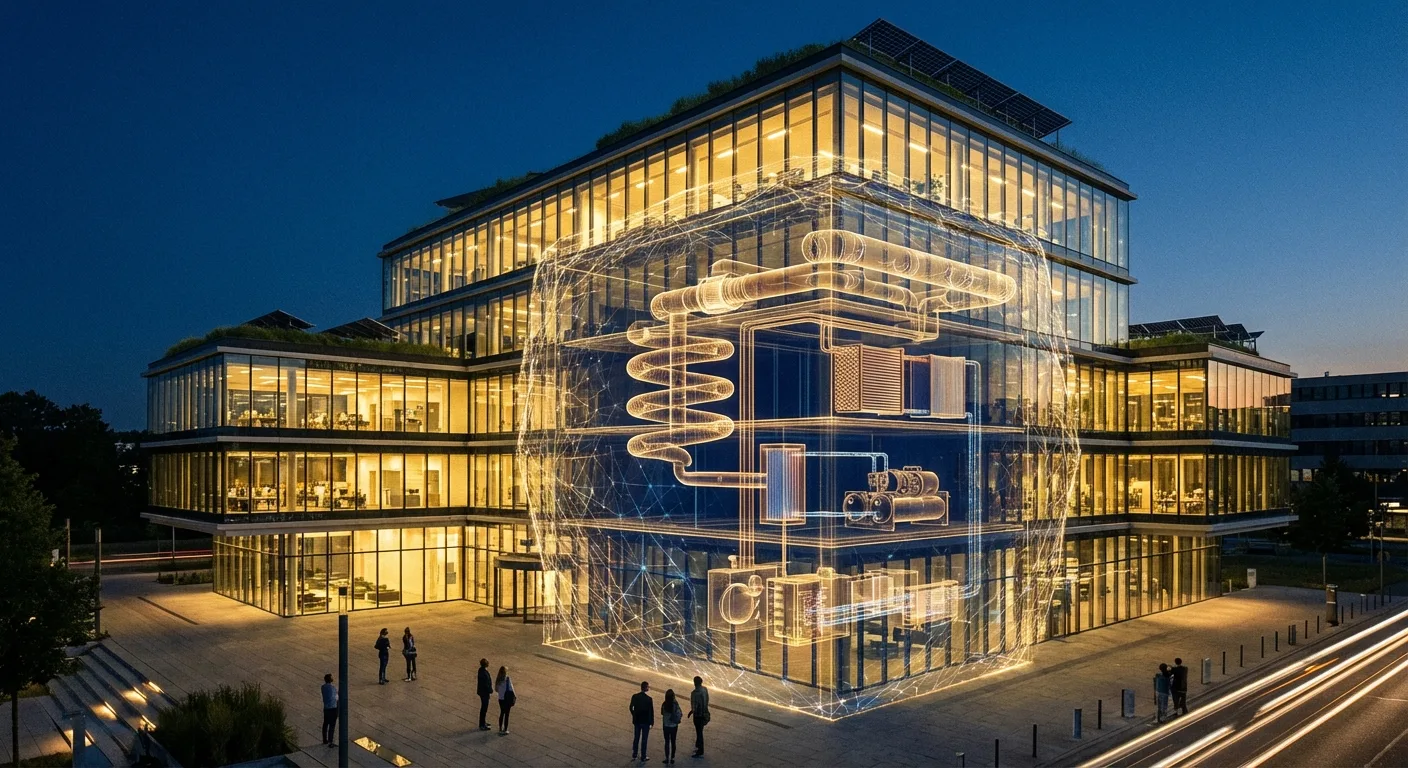
A digital twin is a real-time mirror of a physical building and its HVAC system in the digital world. Unlike traditional Building Energy Models (BEM), a digital twin continuously synchronizes with the real system — receiving real-time sensor data, updating model parameters, and providing simulation predictions for future operating scenarios.
The Fusion of EnergyPlus and AI
EnergyPlus[1], developed by the U.S. Department of Energy (DOE), is the world's most widely used building energy simulation engine. Combining EnergyPlus with AI enables:
- Automatic Model Calibration: Using ML algorithms (such as Bayesian optimization) to automatically adjust EnergyPlus model parameters so that simulation results match measured data. ASHRAE Guideline 14-2023[2] defines the statistical standards for building energy model calibration (CV-RMSE ≤ 15%)
- Rapid Surrogate Models: Training ML surrogate models on EnergyPlus simulation results to accelerate computation by thousands of times, making real-time optimization possible
- Scenario Analysis: Simulating the long-term energy impact of equipment replacement, control strategy changes, or climate change
Architectural Layers of Digital Twins
The building digital twin architecture proposed by O'Neill (2016)[3] comprises three layers: the data integration layer (connecting BMS, IoT sensors, and external data), the model engine layer (fusion of physics models and ML models), and the application services layer (FDD, optimization, energy prediction, etc.). This architecture clearly illustrates how the technologies discussed in the previous three articles are integrated within a unified digital twin framework.
3. Generative AI and LLMs in HVAC Engineering
The rapid development of Large Language Models (LLMs) is opening entirely new application scenarios. For HVAC engineering, potential applications of generative AI include:
Design Assistance
- Load Calculation Automation: LLMs interpret architectural drawings and space requirements, automatically generating initial assumptions and parameter settings for load calculations
- Code and Standards Lookup: Engineers query ASHRAE standards, building codes, and equipment technical documents using natural language, with LLMs providing relevant clauses and explaining their applicability
- Design Scheme Comparison: Automatically generating technical comparative analyses of multiple HVAC system options based on engineering requirements
O&M Intelligent Assistant
Chen and Norford (MIT) explored the role of ML in building O&M decision support in their 2020 research[4]. Generative AI can further extend this concept into an O&M assistant with a natural language interface — facility managers can ask in plain language "Why is today's electricity bill higher than last week?", and the AI assistant analyzes BMS data to report possible causes and recommended improvement measures in text.
Limitations and Risks of LLMs
It is essential to clearly recognize that LLM applications in HVAC engineering are still in an early exploratory stage. The "hallucination" problem of LLMs — generating content that appears plausible but is actually incorrect — poses an unacceptable risk for engineering applications. HVAC system design and control directly affect building safety and occupant health, so any AI-assisted tool must undergo rigorous engineering validation.
4. Edge Computing and Federated Learning
Moving AI inference from the cloud to edge devices at the building site can solve the triple challenge of latency, bandwidth, and data privacy:
Advantages of Edge AI
- Low Latency: Real-time control requires millisecond-level response times; cloud round-trip delays may affect control quality
- Bandwidth Savings: Large volumes of high-frequency sensor data are processed at the edge, with only summaries and anomaly events uploaded to the cloud
- Data Privacy: Sensitive information such as building energy consumption data and usage patterns remains on-site
Federated Learning: Sharing Knowledge Without Sharing Data
Federated Learning allows AI models across multiple buildings to train collaboratively without centralizing each building's raw data on a single server. Each building trains its model locally and uploads only model parameter updates (not raw data) to a central server for aggregation. The significance for HVAC engineering is that property management companies can leverage the collective experience of dozens of buildings to improve each building's AI model performance while protecting individual tenant data privacy.
5. The Evolving Role of Engineers
AI will not replace HVAC engineers, but it will profoundly change their working methods and skill requirements:
- From Calculator to Decision Maker: Repetitive tasks such as load calculations and pipe hydraulic calculations are handled by AI tools; the engineer's value shifts to engineering judgment, scheme selection, and quality assurance
- From Operator to Supervisor: AI optimization controllers handle daily operational decisions; engineers are responsible for overseeing AI system reliability, setting boundary conditions, and handling exceptions
- From Single Discipline to Cross-Domain Integration: Understanding the basic concepts of data science is necessary to effectively collaborate with AI teams and evaluate the applicability of AI tools
- From Case Experience to Systematic Knowledge: AI can analyze operational data from hundreds of buildings; engineers need to elevate from individual case experience to systematic industry insight
Chapter 19 of the ASHRAE Handbook — Fundamentals[5], with its systematic treatment of energy estimation and modeling methods, reminds us that no matter how advanced AI tools become, an engineer's understanding of fundamental principles — thermodynamics, fluid mechanics, heat transfer — remains irreplaceable. AI is a tool, not a replacement.
6. A 2035 Outlook: Grid-Interactive Efficient Buildings
The Grid-Interactive Efficient Buildings (GEB) vision proposed by the U.S. Department of Energy envisions buildings transforming from passive energy consumers into active participants in the electrical grid. In this vision, a building's HVAC system can perform real-time load regulation based on grid demand — pre-cooling and storing energy when electricity is abundant, and curtailing load when supply is tight.
Professor Nagy's team at LBNL demonstrated the potential of multi-agent reinforcement learning in building-grid interactions through the MERLIN (Multi-agent Energy Resource Learning and Integration Network) research project[6]. When AI controllers in thousands of buildings can coordinate their interactions, the building cluster becomes a Virtual Power Plant, providing ancillary services such as demand response and frequency regulation to the grid.
GEB Opportunities for Taiwan
Taiwan's power system faces grid stability challenges arising from increasing renewable energy integration. Building HVAC systems, as the largest flexible load resource, could provide critical support for grid stability if AI-controlled demand response can be realized. Taipower's demand response programs already offer economic incentives, but technically, AI optimization controllers are still needed to achieve millisecond-level load regulation.
Conclusion
From a single temperature reading from a sensor to the intelligent interaction between building clusters and the electrical grid — this four-part series has attempted to map the complete technology spectrum of AI in the HVAC field. Data is the foundation, FDD is the guardian, optimization is the engine for pursuing excellence, and digital twins and generative AI are the bridges connecting the present to the future. HVAC engineers do not need to become AI experts, but they do need to understand AI's capability boundaries and application logic to seize opportunities in this technological transformation and continue creating comfortable, efficient, and sustainable indoor environments for building occupants.